Showing posts with label Romon. Show all posts

Saturday, January 30, 2016

Masumida Jinja Shrine

As I have written in the previous post, hubby and I had been to hubby’s ancestral home in Ichinomiya City of Aichi prefecture during the New Year holidays. We enjoyed our stay at home and celebrated the holidays with many unique customs. One of the customs and traditions during the New Year is to visit a shrine or a temple. This first trip to a shrine or a temple is known as Hatsumode. Hatsumode festivities are held at practically every shrine and temple across the country. People often visit a shrine after midnight on December 31st or sometime during the day on January 1st. It is also a sort of annual ritual and tradition for us to visit a nearby shrine wherever we are during the New Year holidays. This year, although we were unable to visit a shrine on the first day itself, we visited Masumida Jinja Shrine located in the city in the afternoon of 4th January.


Masumida Jinja is a Shinto shrine located in Ichinomiya City. The shrine had the highest shrine rank called Ichinomiya of the former Owari province. In fact the city got its name Ichinomiya from the rank of this shrine. The date of the foundation of the shrine is unknown but the historical Kujiki records indicate that the shrine was founded in 628 BC. The shrine is also mentioned in the early Heian period Engishiki records and was styled as the highest ranked Ichinomiya shrine of Owari province since the end of the Heian period. The shrine enjoyed the support and protection of Oda clan followed by Tokugawa Shogunate until the end of Edo period. After the Meiji Restoration, the shrine was granted the status of second ranked national shrine called Kokuhei Chusha in 1875. The primary god or Kami of the shrine is Amenohoakari no Mikoto who appears in the Kujiki records as a descendant of Amaterasu, and the ancestor of the prehistoric Owari clan.


Hubby and I visited Masumida Jinja Shrine in the afternoon of 4th January. We borrowed my father-in-law’s car and left our home at about 2 pm. The shrine is located about 5 kilometers east of our home and it took us just 10 minutes to reach there by car. After parking the car at a parking lot, we walked along a street for about 10 minutes and reached the shrine. We saw that a huge crowd had come to do Hatsumode ritual that day. At the entrance area of the shrine, we saw a stone monument called Shagohyo with the name of the shrine inscribed on it. After the collapse of an earlier stone monument in July 1929, the present one was built in August of the same year. The calligraphy inscription on the monument was done by a person named Oshima Kimikawa of Nagoya City. Shagohyo monument looked so exquisite. We also saw a huge elegant stone Torii Gate located at the entrance of the shrine precinct. In addition, we saw a pair of Kadomatsu displayed on either side of this gate. A Kadomatsu is a traditional decoration of the New Year placed in front of homes or shrines to welcome the ancestral spirits or the god of the harvest.
I am standing in front of Masumida Jinja Shrine precinct. Shagohyo monument is seen on the right side of the photo (red arrow).

I am standing in front of the stone Torii Gate of the shrine

I am standing next to a Kadomatsu decoration


We walked past the Torii Gate and saw a makeshift bamboo water house named Temizuya located right in front of us in the shrine precinct. At Temizuya we washed our hands and rinsed our mouth before offering prayers at the shrine. It is a symbolic act to clean the mind and body of impurity. It should be mentioned that there is a Temizuya located further inside the shrine precinct and this makeshift bamboo Temizuya was constructed just for the purpose of catering to the huge crowd visiting the shrine for Hatsumode celebrations. As we continued walking towards the shrine buildings, we saw a huge banner with ‘Hatsumode route’ written on it. Because of the large number of visitors to the shrine during the New Year holidays, this banner served as a sort of route guidance to the worshippers. After walking for a few more steps, we saw a sacred bridge named Shinkyo Soribashi. It is a very short stone bridge with a steep graceful arch. This bridge is traditionally and customarily the gateway from the real world to the sacred premises of the shrine. Visitors are not allowed to walk over the bridge. So we walked along the pathway adjacent to the bridge. Walking further for a few more steps, we saw a huge wooden plaque board called Ema with the picture of a monkey displayed on it. Monkey is this year’s zodiac animal. The front of the shrine precinct looked so elegant and peaceful.
I am washing my hands at a makeshift Temizuya

Hubby and the huge banner with ‘Hatsumode route’ written on it

Shinkyo Soribashi arched stone bridge

I am standing near a wooden Ema plaque with the picture of a monkey displayed on it

Hubby standing at the front side of the shrine precinct


Next we saw a beautiful huge wooden main gate named Romon. The present gate structure was constructed in 1961. It is decorated with gold accents and projects an imposing, strong, and protective quality. We also saw an elegant crest engraved on both the doors of the gate. The crest has nine leaves of bamboo inside a wheel of bamboo. The crest reminded us of the ancient Samurai history of Japan. We appreciated the gate and its architecture for some time and took a few photos of the gate from various positions and angles. Afterwards we passed through Romon Gate and stood in the most sacred premises of the shrine.
Romon Gate

I am standing next to the crest engraved on one of the doors of the gate

Backside of the gate as viewed from inside the sacred premises of the shrine

Backside of the gate as viewed from further inside the sacred premises


After passing through Romon Gate, we saw the main buildings of the shrine right in front of us. The main buildings consist of Haiden Prayer Hall in the front and Honden Main Hall behind (north of) Haiden Hall. The construction of these two buildings was completed in 1957. Kami god is enshrined inside Honden Main Hall. This Main Hall is not visible from the front side of the shrine precinct and people are generally not allowed to enter inside this hall. Worshippers pray at Haiden Prayer Hall. The Prayer Hall is a wooden building with intricately carved ornamented roof. Beautiful rotund braided rice straw rope called Shimenawa hangs at the entrance of the Prayer Hall. The Prayer Hall building looked so simple, elegant, and graceful. We loved the architecture of the Prayer Hall and took several photos of the building.
I am posing in front of Haiden Prayer Hall

Enlarged view of the Prayer Hall

People waiting patiently in front of the Prayer Hall

Intricately carved ornamented roof of the Prayer Hall and rotund Shimenawa rope hanging at the entrance of the hall


There was a big crowd of people in front of us waiting to offer their prayers at Haiden Prayer Hall. We had to wait for almost an hour to offer our prayers. Finally when we reached the altar of the Prayer Hall, I offered some coins into the offertory box, clapped my hands twice, and prayed. I prayed for the well being of my family as well as friends. While praying I noted that two priests were performing some ceremony inside the hall.
I am praying in front of Haiden Prayer Hall

Priests performing some ceremony inside the hall


Next we leisurely walked around inside the sacred premises of the shrine. To the east of the main buildings, we saw a beautiful statue of a horse called Shinme that is considered to be sacred and divine in Shinto religion. Afterwards we walked towards the west of the main buildings where we saw a well called Shinsuisha. When Emperor Meiji visited this shrine on 25th October 1878, he drank this well water during luncheon. We loved seeing this historical well. Next we went to a shop located near Shinsuisha, and bought a pair of cute monkey dolls which are supposed to beckon better luck. Monkey is this year’s zodiac animal.
I am standing in front of the statue of Shinme horse

Shinsuisha Well

A pair of cute monkey dolls


Afterwards we came out of Romon Gate and left the most sacred premises of the shrine. Outside this gate, adjacent to the makeshift water house Temizuya, we saw a decoration of several huge barrels of Sake rice wine called Kazaridaru. The Sake barrels were wrapped in straw blankets, and were stacked and bound together by rope on a wooden frame. These decorative barrels are offerings to the god of the shrine.
I am standing in front of several huge barrels of Sake


Hubby and I loved visiting Masumida Jinja Shrine for Hatsumode festivities during the New Year holidays.

Tuesday, March 19, 2013

Kunozan Toshogu Shrine

On 4th January, hubby and I visited Kunozan Toshogu Shrine in the city of Shizuoka in Shizuoka prefecture. The shrine is located near the top of Mount Kuno in Suruga Ward of the city. We climbed 1159 stone steps up the walkway from the foot of the mountain to the top in about an hour. As I wrote in the previous post, the climb up the 216-meter-high steep mountain was a bit tiring but we were rewarded with magnificent views during the climb.


Kunozan Toshogu Shrine is dedicated to Tokugawa Ieyasu who was the first Shogun of Tokugawa Shogunate. The shrine is located at the top of Mount Kuno and was the original burial place of Ieyasu. The mountain was the site of a Buddhist temple named Kunoji, which dated to at least the early Nara period. In 1568, a feudal warlord named Takeda Shingen moved the temple to a nearby place that is now called Shimizu-ku, and built a castle on Mount Kuno. In 1582, Takeda clan was defeated by Tokugawa Ieyasu and Suruga province along with Kuno Castle came under the control of Tokugawa clan. Ieyasu formed Edo Government in 1603 and then retired to a nearby Sunpu Castle in 1607. However, he considered Kuno Castle to be important and so he continued to maintain the castle. He wished to be buried at the top of Mount Kuno, and therefore as per his wishes he was buried at the mountaintop after his death in 1616. In 1617, Tokugawa Hidetada, second Shogun and son of Ieyasu, built Kunozan Toshogu Shrine as a mausoleum of Ieyasu at the site of Kuno Castle. At the first anniversary of Ieyasu’s death, his grave was relocated to Nikko in Shimotsuke province (present Tochigi prefecture) where a shrine with the same name as Toshogu was built and Ieyasu was deified by the third Shogun Tokugawa Iemitsu. However a portion of his deified spirit is said to still reside on Mount Kuno. Kunozan Toshogu Shrine was originally built in the mixed style of Buddhism and Shintoism.  After the Meiji Government overthrew the Tokugawa Shogunate, and the subsequent separation of the two religions, some of the Buddhist structures were removed or remodeled. The primary enshrined kami (god) at this shrine is Tosho-Daigongen which is the deified spirit of Tokugawa Ieyasu. From Meiji period, two secondary kami, the spirits of Toyotomi Hideyoshi and Oda Nobunaga are also enshrined here. Presently the sacred grounds of the shrine complex consist of thirteen gorgeous structures and all of them are original. All these structures are bright red buildings decorated with gold accents and colorful carvings and paintings. The buildings named Honden, Haiden, and Ishinoma are designated as national treasures. All other buildings are designated as important cultural properties. This shrine is the oldest of all the Toshogu shrines.


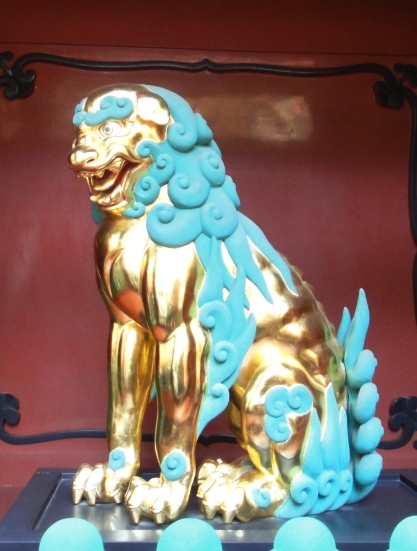
As I wrote in the previous post, hubby and I climbed up the walkway from the base of Mount Kuno and took about an hour to reach near the top of the mountain where the shrine is located. Adjacent to the souvenir shops and food stalls at the mountaintop, there is a ticket counter from where we bought tickets worth 500 Yen per person to enter the sacred grounds of the shrine. From the ticket booth area we could see Romon Gate of the shrine. Romon Gate is gorgeous and delimits the shrine premises. We climbed several stone steps and reached near the gate which is an elaborate wooden red colored structure decorated with gold accents and colorful carvings and paintings. It is said that the name of the shrine written on the beautiful framed plaque hanging from the second floor of this gate building was carved by Emperor Go-mizunoo himself. This gate is designated as an important cultural property. On reaching the gate, we saw that two wooden statues of Zuijin warrior guardians armed with bows and arrows are located on each side of the gate to protect the entrance and the grounds of this shrine from evil spirits. Zuijin were high-ranking court guardians to the nobles in Heian period. The statue on the right side of the gate is called Udaijin and the one on the left side is called Sadaijin. On entering inside the gate we saw a pair of golden and green colored guardian statues flanking the backside of the gate. The statue on the right side of the gate (orientation from inside the sacred grounds) is called Ungyo Komainu and the one on the left side is called Agyo Shishi. We loved seeing the colorful gate and all the beautiful statues.
I am standing next to the ticket counter and about to start climbing up the stone steps leading to Romon Gate

I am posing after climbing only a few steps of the walkway

Hubby and Romon Gate in the background

I am climbing further up the steps leading to the gate

I am standing near the gate

Udaijin guardian statue to the right side of the gate

Sadaijin guardian statue to the left side of the gate

Romon Gate as viewed from inside the sacred grounds of the shrine

Ungyo Komainu statue to the right side of the gate (orientation from inside)

Agyo Shishi statue to the left side of the gate


We walked along the walkway for several meters and saw Temizuya to our left. Temizuya is a hand washing basin with a roof supported by four pillars. We washed our hands with water at the basin and purified ourselves. Then we climbed a few steps along the walkway and reached a stone Torii Gate.
Walkway and the stone Torii Gate

Temizuya basin located on the left side of the photo


After crossing the Torii Gate, we walked along the walkway and saw a beautiful red building named Korou to our right side. There are colorful carvings and gold accents on the ceiling and walls of this building. The building was originally a Buddhist structure that was used as a bell tower. But during the Meiji period, it was remodeled as a Shinto structure and now holds Taiko drums. Korou is designated as an important cultural property.
Walkway leading to the shrine and Korou partly visible on the right side of the photo

Korou


We climbed a few more steps along the walkway and then saw another red building named Kaguraden to our right side. Although the name Kaguraden suggests that it is a building to hold Shinto theatrical dance named Kagura, no such performance takes place here. Presently people hang Ema wooden plaques inside this building. Kaguraden is designated as an important cultural property.
Climbing a few more steps along the walkway

Kaguraden located to our right side

Hubby is standing on the walkway next to copper lanterns and appreciating Kaguraden (not seen). The next gate of the shrine is seen up the walkway.


Next we climbed the last few stone steps along the walkway. While climbing these steps, we turned around to view and appreciate the shrine grounds where we saw many visitors who had come to offer Hatsumode prayers for the New Year celebrations. At the end of the walkway, we reached a gorgeous red colored gate with a magnificent roof. This gate named Karamon Gate is the entrance to the shrine hall named Haiden. The gate has arched Chinese style roof with exquisite colorful wood carvings, gold accents, and painted decorations. The gate has painted carvings of dragons, peacocks, mythical beasts, flowers, leaves, and many other interesting subjects. This colorful styled ornate gate is designated as an important cultural property. We took several photos of the gate from various positions and angles.
Shrine grounds along with Kaguraden and Korou buildings on the left side of the photo

Karamon Gate

Ornate roof and ceiling of Karamon Gate

Colorful painted carvings and gold accents on the ceiling of the gate


Colorful carvings and gold accents on the doors and lintel of the gate

More colorful carvings on the lintel of the gate


After passing through Karamon Gate, we reached a small praying area which is a roofed structure with no walls. This praying area is located right in front of the worship hall named Haiden Hall, and we could clearly see the ornate altar of the hall. I offered some coins into the offertory box, clapped my hands twice, and prayed for the well being of my family as well as friends. Hubby compiled a video of me praying.
Roofed praying area and beyond it is the altar of Haiden Hall

People praying

I almost reached the front of the praying area and am ready to offer prayers. Huge offertory boxes are seen on the right side of the photo.

A compiled video of me praying


Next we saw the main building named Shaden which is the focal point of the shrine. Shaden consists of three buildings named Honden Main Hall, Ishinoma Interconnecting Hall, and Haiden Worship Hall. Shaden is dedicated to Tokugawa Ieyasu, and was built by his son Tokugawa Hidetada in 1617. This main building is a fantastic wooden structure built by a famous carpenter named Nakai Masakiyo in just 19 months. The architectural design of this kind of building is known as Gongen-zukuri. At that time, this was the most advanced architectural technology. In fact, the Gongen-zukuri style of constructing the Shaden was established at this shrine, and therefore this shrine is the oldest of all the Toshogu shrines. Later the same architectural style was adopted by other Toshogu shrines including the one at Nikko City. The Shaden building shows the flamboyant colorful style of the late Momoyama period, with extravagant wood carvings, gold leaf, and painted decorations over black lacquer. The primary enshrined god in Honden Main Hall is Tosho-Daigongen which is the deified spirit of Tokugawa Ieyasu. In addition, two secondary gods, the spirits of Toyotomi Hideyoshi and Oda Nobunaga are also enshrined. Honden, Haiden, and Ishinoma have been designated as national treasures in 2010. We loved viewing the Shaden building which is designed so beautifully and the details of the decorations are astounding. We took several photos of the building from various positions and angles.
Roofs of Honden Main Hall (right side) and Haiden Worship Hall (left side) as viewed from the east side of the sacred grounds of the shrine

Haiden Hall as viewed from the southeast

Beautiful colored carvings on the ceiling of Haiden Hall

Colored carvings on the ceiling of Haiden Hall

Haiden Hall and the praying area in front of the hall as viewed from the south

Front of Haiden Hall as viewed from the praying area

Stunning colorful carvings and gold accents on the ceiling and the front side of Haiden Hall

Enlarged view of the carvings and paintings on the ceiling and the front side of Haiden Hall

Haiden Hall as viewed from the southwest

Honden Main Hall as viewed from the west

I am standing next to the extravagantly decorated Honden Hall

Paintings of lion and nature on the western side wall of Honden Hall


Afterwards we walked around in the sacred premises in front of the Shaden building and enjoyed viewing the building some more. Then we went to Omikuji fortune stall located adjacent to Shaden building, and paid 200 Yen to draw the fortune. Omikuji are sacred random fortunes written on strips of paper. Both our strips of paper showed ‘normal luck and fortune’. Later hubby tied the paper strips to a string on the frame set up at the shrine ground.
Hubby is standing in the Shaden area of the shrine. The gate (indicated by red arrow) seen behind him is the side gate which can also be used to enter inside the Shaden area.

Hubby reading Omikuji fortune written on a strip of paper

Hubby tying the strip of paper to a string


Next we left the Shaden building area using the side gate located on the east side of the sacred premises, and saw a subsidiary red colored shrine named Hie Jinja right in front of us. Hie Jinja is dedicated to Oyamakui-no-mikoto. Earlier a statue of Yakushi Nyorai was enshrined here but during the Meiji period the statue was moved to a nearby temple named Daishoji Temple. Hie Jinja is designated as an Important cultural property.
I am standing near the side gate through which we left the Shaden building area and entered the Hie Jinja area

Hie Jinja

Ornate roof and walls of Hie Jinja as viewed from the west from inside the Shaden building area


We walked down a few stone steps, and saw another red colored building named Shinko located to the southeast of Hie Jinja. Shinko building is constructed in Azekura-zukuri architectural style in the same way as Shosoin building located in Nara City. Shinko is a repository where products and artifacts dedicated to Kunozan Toshogu Shrine are stored. Shinko is designated an important cultural property.
Shinko


Later we went back inside the Shaden building sacred area and again viewed and appreciated various buildings of the premises. Afterwards we visited the mausoleum of Tokugawa Ieyasu located further up Mount Kuno. I will write about the Mausoleum in the next post.