Showing posts with label Karamon. Show all posts

Tuesday, March 19, 2013

Kunozan Toshogu Shrine

On 4th January, hubby and I visited Kunozan Toshogu Shrine in the city of Shizuoka in Shizuoka prefecture. The shrine is located near the top of Mount Kuno in Suruga Ward of the city. We climbed 1159 stone steps up the walkway from the foot of the mountain to the top in about an hour. As I wrote in the previous post, the climb up the 216-meter-high steep mountain was a bit tiring but we were rewarded with magnificent views during the climb.


Kunozan Toshogu Shrine is dedicated to Tokugawa Ieyasu who was the first Shogun of Tokugawa Shogunate. The shrine is located at the top of Mount Kuno and was the original burial place of Ieyasu. The mountain was the site of a Buddhist temple named Kunoji, which dated to at least the early Nara period. In 1568, a feudal warlord named Takeda Shingen moved the temple to a nearby place that is now called Shimizu-ku, and built a castle on Mount Kuno. In 1582, Takeda clan was defeated by Tokugawa Ieyasu and Suruga province along with Kuno Castle came under the control of Tokugawa clan. Ieyasu formed Edo Government in 1603 and then retired to a nearby Sunpu Castle in 1607. However, he considered Kuno Castle to be important and so he continued to maintain the castle. He wished to be buried at the top of Mount Kuno, and therefore as per his wishes he was buried at the mountaintop after his death in 1616. In 1617, Tokugawa Hidetada, second Shogun and son of Ieyasu, built Kunozan Toshogu Shrine as a mausoleum of Ieyasu at the site of Kuno Castle. At the first anniversary of Ieyasu’s death, his grave was relocated to Nikko in Shimotsuke province (present Tochigi prefecture) where a shrine with the same name as Toshogu was built and Ieyasu was deified by the third Shogun Tokugawa Iemitsu. However a portion of his deified spirit is said to still reside on Mount Kuno. Kunozan Toshogu Shrine was originally built in the mixed style of Buddhism and Shintoism.  After the Meiji Government overthrew the Tokugawa Shogunate, and the subsequent separation of the two religions, some of the Buddhist structures were removed or remodeled. The primary enshrined kami (god) at this shrine is Tosho-Daigongen which is the deified spirit of Tokugawa Ieyasu. From Meiji period, two secondary kami, the spirits of Toyotomi Hideyoshi and Oda Nobunaga are also enshrined here. Presently the sacred grounds of the shrine complex consist of thirteen gorgeous structures and all of them are original. All these structures are bright red buildings decorated with gold accents and colorful carvings and paintings. The buildings named Honden, Haiden, and Ishinoma are designated as national treasures. All other buildings are designated as important cultural properties. This shrine is the oldest of all the Toshogu shrines.


As I wrote in the previous post, hubby and I climbed up the walkway from the base of Mount Kuno and took about an hour to reach near the top of the mountain where the shrine is located. Adjacent to the souvenir shops and food stalls at the mountaintop, there is a ticket counter from where we bought tickets worth 500 Yen per person to enter the sacred grounds of the shrine. From the ticket booth area we could see Romon Gate of the shrine. Romon Gate is gorgeous and delimits the shrine premises. We climbed several stone steps and reached near the gate which is an elaborate wooden red colored structure decorated with gold accents and colorful carvings and paintings. It is said that the name of the shrine written on the beautiful framed plaque hanging from the second floor of this gate building was carved by Emperor Go-mizunoo himself. This gate is designated as an important cultural property. On reaching the gate, we saw that two wooden statues of Zuijin warrior guardians armed with bows and arrows are located on each side of the gate to protect the entrance and the grounds of this shrine from evil spirits. Zuijin were high-ranking court guardians to the nobles in Heian period. The statue on the right side of the gate is called Udaijin and the one on the left side is called Sadaijin. On entering inside the gate we saw a pair of golden and green colored guardian statues flanking the backside of the gate. The statue on the right side of the gate (orientation from inside the sacred grounds) is called Ungyo Komainu and the one on the left side is called Agyo Shishi. We loved seeing the colorful gate and all the beautiful statues.
I am standing next to the ticket counter and about to start climbing up the stone steps leading to Romon Gate

I am posing after climbing only a few steps of the walkway

Hubby and Romon Gate in the background

I am climbing further up the steps leading to the gate

I am standing near the gate

Udaijin guardian statue to the right side of the gate

Sadaijin guardian statue to the left side of the gate

Romon Gate as viewed from inside the sacred grounds of the shrine

Ungyo Komainu statue to the right side of the gate (orientation from inside)
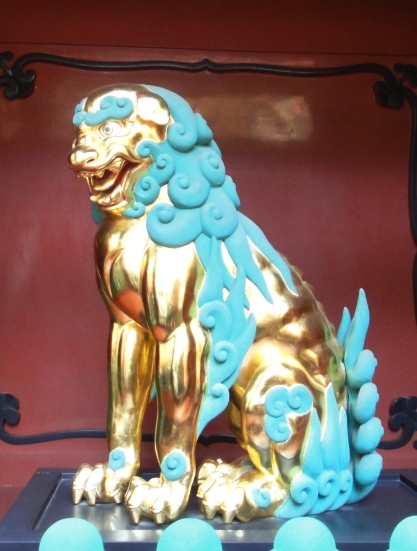
Agyo Shishi statue to the left side of the gate


We walked along the walkway for several meters and saw Temizuya to our left. Temizuya is a hand washing basin with a roof supported by four pillars. We washed our hands with water at the basin and purified ourselves. Then we climbed a few steps along the walkway and reached a stone Torii Gate.
Walkway and the stone Torii Gate

Temizuya basin located on the left side of the photo


After crossing the Torii Gate, we walked along the walkway and saw a beautiful red building named Korou to our right side. There are colorful carvings and gold accents on the ceiling and walls of this building. The building was originally a Buddhist structure that was used as a bell tower. But during the Meiji period, it was remodeled as a Shinto structure and now holds Taiko drums. Korou is designated as an important cultural property.
Walkway leading to the shrine and Korou partly visible on the right side of the photo

Korou


We climbed a few more steps along the walkway and then saw another red building named Kaguraden to our right side. Although the name Kaguraden suggests that it is a building to hold Shinto theatrical dance named Kagura, no such performance takes place here. Presently people hang Ema wooden plaques inside this building. Kaguraden is designated as an important cultural property.
Climbing a few more steps along the walkway

Kaguraden located to our right side

Hubby is standing on the walkway next to copper lanterns and appreciating Kaguraden (not seen). The next gate of the shrine is seen up the walkway.


Next we climbed the last few stone steps along the walkway. While climbing these steps, we turned around to view and appreciate the shrine grounds where we saw many visitors who had come to offer Hatsumode prayers for the New Year celebrations. At the end of the walkway, we reached a gorgeous red colored gate with a magnificent roof. This gate named Karamon Gate is the entrance to the shrine hall named Haiden. The gate has arched Chinese style roof with exquisite colorful wood carvings, gold accents, and painted decorations. The gate has painted carvings of dragons, peacocks, mythical beasts, flowers, leaves, and many other interesting subjects. This colorful styled ornate gate is designated as an important cultural property. We took several photos of the gate from various positions and angles.
Shrine grounds along with Kaguraden and Korou buildings on the left side of the photo

Karamon Gate

Ornate roof and ceiling of Karamon Gate

Colorful painted carvings and gold accents on the ceiling of the gate


Colorful carvings and gold accents on the doors and lintel of the gate

More colorful carvings on the lintel of the gate


After passing through Karamon Gate, we reached a small praying area which is a roofed structure with no walls. This praying area is located right in front of the worship hall named Haiden Hall, and we could clearly see the ornate altar of the hall. I offered some coins into the offertory box, clapped my hands twice, and prayed for the well being of my family as well as friends. Hubby compiled a video of me praying.
Roofed praying area and beyond it is the altar of Haiden Hall

People praying

I almost reached the front of the praying area and am ready to offer prayers. Huge offertory boxes are seen on the right side of the photo.

A compiled video of me praying


Next we saw the main building named Shaden which is the focal point of the shrine. Shaden consists of three buildings named Honden Main Hall, Ishinoma Interconnecting Hall, and Haiden Worship Hall. Shaden is dedicated to Tokugawa Ieyasu, and was built by his son Tokugawa Hidetada in 1617. This main building is a fantastic wooden structure built by a famous carpenter named Nakai Masakiyo in just 19 months. The architectural design of this kind of building is known as Gongen-zukuri. At that time, this was the most advanced architectural technology. In fact, the Gongen-zukuri style of constructing the Shaden was established at this shrine, and therefore this shrine is the oldest of all the Toshogu shrines. Later the same architectural style was adopted by other Toshogu shrines including the one at Nikko City. The Shaden building shows the flamboyant colorful style of the late Momoyama period, with extravagant wood carvings, gold leaf, and painted decorations over black lacquer. The primary enshrined god in Honden Main Hall is Tosho-Daigongen which is the deified spirit of Tokugawa Ieyasu. In addition, two secondary gods, the spirits of Toyotomi Hideyoshi and Oda Nobunaga are also enshrined. Honden, Haiden, and Ishinoma have been designated as national treasures in 2010. We loved viewing the Shaden building which is designed so beautifully and the details of the decorations are astounding. We took several photos of the building from various positions and angles.
Roofs of Honden Main Hall (right side) and Haiden Worship Hall (left side) as viewed from the east side of the sacred grounds of the shrine

Haiden Hall as viewed from the southeast

Beautiful colored carvings on the ceiling of Haiden Hall

Colored carvings on the ceiling of Haiden Hall

Haiden Hall and the praying area in front of the hall as viewed from the south

Front of Haiden Hall as viewed from the praying area

Stunning colorful carvings and gold accents on the ceiling and the front side of Haiden Hall

Enlarged view of the carvings and paintings on the ceiling and the front side of Haiden Hall

Haiden Hall as viewed from the southwest

Honden Main Hall as viewed from the west

I am standing next to the extravagantly decorated Honden Hall

Paintings of lion and nature on the western side wall of Honden Hall


Afterwards we walked around in the sacred premises in front of the Shaden building and enjoyed viewing the building some more. Then we went to Omikuji fortune stall located adjacent to Shaden building, and paid 200 Yen to draw the fortune. Omikuji are sacred random fortunes written on strips of paper. Both our strips of paper showed ‘normal luck and fortune’. Later hubby tied the paper strips to a string on the frame set up at the shrine ground.
Hubby is standing in the Shaden area of the shrine. The gate (indicated by red arrow) seen behind him is the side gate which can also be used to enter inside the Shaden area.

Hubby reading Omikuji fortune written on a strip of paper

Hubby tying the strip of paper to a string


Next we left the Shaden building area using the side gate located on the east side of the sacred premises, and saw a subsidiary red colored shrine named Hie Jinja right in front of us. Hie Jinja is dedicated to Oyamakui-no-mikoto. Earlier a statue of Yakushi Nyorai was enshrined here but during the Meiji period the statue was moved to a nearby temple named Daishoji Temple. Hie Jinja is designated as an Important cultural property.
I am standing near the side gate through which we left the Shaden building area and entered the Hie Jinja area

Hie Jinja

Ornate roof and walls of Hie Jinja as viewed from the west from inside the Shaden building area


We walked down a few stone steps, and saw another red colored building named Shinko located to the southeast of Hie Jinja. Shinko building is constructed in Azekura-zukuri architectural style in the same way as Shosoin building located in Nara City. Shinko is a repository where products and artifacts dedicated to Kunozan Toshogu Shrine are stored. Shinko is designated an important cultural property.
Shinko


Later we went back inside the Shaden building sacred area and again viewed and appreciated various buildings of the premises. Afterwards we visited the mausoleum of Tokugawa Ieyasu located further up Mount Kuno. I will write about the Mausoleum in the next post.

Sunday, July 24, 2011

Toyokuni Jinja, Hokoji Temple, and Hokokubyo Mausoleum

On the morning of 2nd May, hubby and I visited Toyokuni Jinja Shrine, Hokoji Temple, and Hokokubyo Mausoleum in Kyoto. We left the hotel at about 8 am, and reached Kyoto Railway station at 9 am. Inside the station, we saw gogatsu ningyo exhibited on the north-south passage near the central Karasuma exit. Gogatsu ningyo are the dolls exhibited during the traditional Boys’ Day on 5th May. Nowadays this day is celebrated as Children’s Day. The exhibited dolls were the armors and helmets of Oda Nobunaga, Toyotomi Hideyoshi, and Tokugawa Ieyasu who were the greatest men in Japanese history and are known as the three unifiers of Japan.
Gogatsu ningyo exhibited inside Kyoto Railway Station

Armor and helmet of Oda Nobunaga

Armor and helmet of Toyotomi Hideyoshi

Armor and helmet of Tokugawa Ieyasu


Toyokuni Jinja
Toyokuni Jinja is a Shinto shrine located in eastern Higashiyama area of Kyoto city. The original shrine was built in 1599 and was dedicated to Toyotomi Hideyoshi. The present shrine is the restored shrine to his spirit. The shrine is popularly and affectionately known as Hokoku-san. Hideyoshi died at the age of 63 in 1598. The next year Emperor Goyozei ordered that a Shinto shrine to Hideyoshi’s spirit be constructed at the foot of Mount Amidagamine to the east of Higashi-oji-dori Road since in death Hideyoshi was seen as a god. The emperor granted the shrine the highest shrine rank of Shoichii and bestowed upon its god the name Toyokuni Daimyojin. The shrine became a gathering place for the people of Kyoto on the anniversary of Hideyoshi’s death. In 1604 a particularly magnificent festival was held to mark the seventh anniversary of his death. Such esteem for his predecessor concerned the new Tokugawa Shogunate. As a result, Tokugawa Ieyasu, the first Tokugawa Shogun, annulled the enshrinement of Hideyoshi in the shrine in 1615. However, with the end of Tokugawa Edo Period in 1868, the new Meiji government began the restoration of Hideyoshi’s reputation and all the shrines connected with him. In April 1868, the Meiji Emperor ordered the restoration of Toyokuni shrine. The shrine was reconstructed during Meiji Period in 1880 at the current site, where Daibutsuden Hall of a temple named Hokoji had previously stood. The shrine was rebuilt on a grand scale and therefore many of the buildings of Hokoji Temple were moved to the north.

Toyokuni Jinja is located about two kilometers northeast of Kyoto Railway Station and it took us ten minutes to reach the shrine by taxi. The shrine is located on Yamato-oji-dori Road where Shomen-dori Road meets Yamato-oji-dori. We reached right in front of a stone Ishitorii Entrance Gate located on the west side of the shrine grounds. Beyond the stone gate, there is a stone paved pathway with a series of lanterns in vermilion painted wood raised on posts on either side of the pathway. To our left towards north, we saw a water house that is used to wash our hands which is a symbolic act to clean the mind and body of impurity before entering the shrine. On the same side of the shrine complex there is a beautiful stone lantern.
I am standing next to a stone monument with Toyokuni Jinja written on it

Hubby standing in front of Ishitorii Gate

Stone paved pathway with red lanterns on wooden posts on either side of the pathway

Water house

Hubby standing next to a stone lantern


The paved pathway leads to a gate named Karamon. It is a Chinese-style gate which is said to have once stood before Hideyoshi’s Fushumi Castle, and was brought to the present location in 1876. The gate has typical Azuchi-Momoyama Period architecture and is now designated as a national treasure of Japan. The gate faces the western side of the shrine complex and from it hangs the original tablet-name for the shrine that was created by Emperor Goyozei in 1599. The roof of the gate is made of cypress bark, and the gate is supported by six large wooden pillars. Fine relief carving of two cranes under the front gable enhances the beauty of the gate. The ornaments of the gate are gold plated. Many gourd-shaped ema votive tablets hang from several stands kept on both sides of the gate.
Karamon Gate

Original tablet-name for the shrine and relief carving of two cranes on either side of the tablet

Many gourd-shaped ema hanging from a stand near Karamon Gate

Another stand with many ema

I am standing in front of the gate

Beautiful carvings on the door of the gate


Beyond Karamon Gate is Haiden Prayer Hall which is a roofed structure with no walls. Right beyond the prayer hall is Honden Main Hall where the spirit of Hideyoshi is enshrined. We could only see a part of Honden Hall as visitors are not allowed beyond Karamon Gate. We prayed to the god from Karamon Gate itself.
Haiden Prayer Hall

Honden Main Hall


To the north of the paved pathway, there is another smaller Shinto shrine named Inaridaimyojin which has a series of small vermilion torii gates in front of it. I prayed at this shrine.
Many vermilion torii gates in front of Inaridaimyojin Shrine

Inaridaimyojin Shrine

I am praying at the shrine


Next, we visited Hokoji Temple which is located adjacent to Toyokuni Jinja.


Hokoji Temple
Hokoji Temple was erected by Toyotomi Hideyoshi in order to build a huge image of Buddha which would outclass the Great Buddha Daibutsu of Nara. It is a Tendai sect temple founded in 1586. The original temple grounds covered an area 238 meters from east to west by 250 meters north to south. Hideyoshi’s vassals furnished the funds and the workers needed to construct the temple. An 18-meters tall image of Buddha was cast in wood and lacquered. Construction of the giant statue reportedly took only three years. A large Daibutsuden Hall was built in 1587 to house this image. In 1596, a great earthquake damaged much of Kyoto area and the image of the Great Buddha was destroyed. Rebuilding of the image of Buddha and the hall began in 1598 but within a month Hideyoshi passed away. Dissension among various lords who had pledged to support Hideyoshi’s five year old son Hideyori as the next political ruler when he came of age, enabled Tokugawa Ieyasu to gain control of the government by 1603. Ieyasu was determined to get rid of Hideyori. So in order to weaken Hideyori financially as the years went by, Ieyasu encouraged him and his mother Yodo-dono to use gold coins from Hideyoshi’s estate to fund the replacement of the Great Buddha. The rebuilding was already underway for a few years but a fire in 1603 destroyed the almost completed bronze statue as well as the main hall. Ieyasu convinced Hideyori and his mother once more that the project had to be completed using the Toyotomi family finances. By 1609 the image of Buddha was recreated in bronze, and by 1612 the temple was restored. However, this new hall and the image of Buddha were destroyed by an earthquake in 1662, and the wooden replacements were lost in a fire in 1798. The new image of 1843, which replaced the previous Buddha, was destroyed in a 1973 fire. Thus, the existing halls of this once spectacular landmark temple are not very important since all that was of consequence has been consumed by many fires. In addition, the reconstruction of Toyokuni Shrine in 1880 was carried out where Daibutsuden Hall of Hokoji once stood. Many of the buildings of Hokoji Temple were moved to the north thereby restricting the temple to but a corner of its original site.

Hokoji Temple today is a rather nondescript complex. The present temple complex is located on the east side of Yamato-oji dori just north of Toyokuni Jinja. We could directly enter the temple grounds from the shrine premises itself as the temple grounds begin at the end of the shrine property. We saw Hondo Main Hall of the temple but it was closed.
Eastern part of Hondo Main Hall as viewed from the south

Western part of Hondo Main Hall as viewed from the south


The temple has a bell which has important historical value. In 1614, to mark the completion of rebuilding the temple and the Great Buddha, a huge bronze bell was cast and mounted in its own structure. It still stands in the temple complex and is 4.3 meters tall, 2.7 meters in diameter, 23 centimeters thick, and weighs 82000 kilograms. Toyotomi Hideyori asked a priest of another temple to write an inscription for this bell. Among numerous Chinese characters, there are words that read as ‘kokka anko kunshin horaku’. It literally means ‘peace of the nation and prosperity of the lord and retainers’. However, Tokugawa Shogunate maliciously contorted these Chinese characters, and Tokugawa Ieyasu affected to take umbrage alleging that it was intended as a curse on him. This is because the second and fourth characters of ‘kokka anko’ are the characters of his name ‘Ieyasu’ which means ‘ka-ko’ or ‘house tranquility’. By placing the character ‘an’ or ‘peace’ in between the two characters of his own name, he claimed that the words in the inscription can be interpreted as: ‘if the body of Ieyasu can be gently lacerated, people would live happily and richly with Toyotomi family’. Although Hideyori apologized profusely, Ieyasu refused to be placated and resorted to armed force. In 1615 he besieged Hideyori in Osaka Castle, a castle Hideyori had inherited from his father. The Toyotomi family was exterminated. Although the bell of this temple was to herald an era of peace but it led to the downfall of Hideyoshi’s son, eradication of Toyotomi line, and strengthening of Tokugawa Edo period for the next 265 years.

Inside the temple complex, the bell stands in Shoro belfry that was rebuilt in 1884. The bell is huge and there are beautiful paintings on the ceiling of Shoro. We took several photos of the bell and Shoro from various positions and angles. This bell is of immense historical significance as it changed the history of Japan. But we were surprised that there were hardly any visitors in the temple grounds.
Shoro belfry as viewed from the west inside the temple complex

Shoro as viewed from the northwest

Shoro as viewed from the east

Hubby standing next to the huge bell

Bell along with paintings on the ceiling of Shoro

Another view of the bell and paintings on the ceiling of Shoro

Portion of beautiful paintings on the ceiling of Shoro

Another portion of the paintings on the ceiling of Shoro

Inscribed Chinese characters on the bell that changed the history of Japan

Enlarged view of the characters

Hubby wrote the characters on a piece of paper and explained its meaning to me


Next we visited Hokokubyo Mausoleum which is located nearby.


Hokokubyo Mausoleum
Toyotomi Hideyoshi passed away on 18th September 1598 at the age of 63 in Fushumi Castle. Hideyoshi’s body was interred in accordance with his wishes halfway up Mount Amidagamine located to the east of Kyoto. The next year, Emperor Goyozei ordered the construction of a magnificent mausoleum and a shrine at the base of the mountain. After the downfall of Toyotomi clan in 1615, Tokugawa Shogunate annulled the enshrinement of Hideyoshi in the mausoleum and the shrine, and both fell into ruins due to neglect and natural elements. The shrine was reconstructed as Toyokuni Jinja in 1880 about which I have already written. In 1898, the gravesite which had fallen into disrepair was reconstructed as Hokokubyo Mausoleum at the summit of Mount Amidagamine. This was done to mark the 300th memorial anniversary of the passing of Hideyoshi.

Hokokubyo Mausoleum is located about 1.3 kilometers southeast of Toyokuni Shrine. It took us just a few minutes to reach the site of the mausoleum by taxi. The base of Mount Amidagamine is presently known as Hokokubyo Taikodaira, and was the location of the original Toyokuni Shrine. There is a gate like structure at the base beyond which we had to climb staircases to reach the mausoleum.
I am standing at Hokokubyo Taikodaira which is at the base of Mount Amidagamine

Greenery all around us at the base of the mountain

Gate like structure beyond which the staircases leading to the summit of the mountain starts

Hubby standing next to an information notice board about the history of the mausoleum


At about 11.30 am, we started climbing the first flight of stairs which were very steep. We were a bit tired after climbing many steps and took rest in between for some time. Afterwards hubby was very energetic but I had great difficulty in climbing the rest of the stairs.
I am climbing up the first flight of stairs

Hubby taking rest for some time

I am having difficulty in climbing the stairs


After climbing for a while again, we reached a plateau located about halfway up the mountain. A Chinese-style gate with gabled roof is present at this point. It is a beautiful structure in the middle of the mountain. Beyond the gate, we could see a second set of staircase leading upward to the mausoleum.
Chinese-style gate at the plateau located halfway up the mountain

Closer view of the gate and the second set of staircase beyond the gate


We started climbing the second flight of stairs. The climb ahead was arduous and I was very tired. Hubby did not have any problem and climbed the stairs at a constant pace. So the distance between hubby and me kept increasing. Finally after about 45 minutes of climbing the stairs, I reached the top of the mountain. By the time I got to the top I was so exhausted that I could hardly walk once I got to the mausoleum itself. Hubby had reached the top almost 15-20 minutes before me. He had counted the number of steps and told me that we had climbed a total of 522 steps to reach the summit of the mountain.
Hubby climbing up the second set of staircase

I am climbing the stairs

Hubby took this photo when he almost reached the summit. I was too tired and was near the bottom of the second set of staircase.

Hubby reached the top of the mountain. Mausoleum is partly seen.


The mausoleum of Toyotomi Hideyoshi stands as a proud centerpiece at the summit of the mountain. Seeing the mausoleum of one of the greatest men in Japanese history was really worth the climb. This mausoleum is a five-tiered stone pagoda tomb, which is commonly known as Gorinto. Each tier of Gorinto corresponds to one of five elements which are earth, water, fire, wind, and void from bottom to top. We took several photos of the mausoleum from various angles and positions. I prayed for peace and happiness at the mausoleum. From the summit, we got a beautiful view of Kyoto city through the trees. No one was around and so we just sat there for almost an hour. The place was so serene and peaceful.
Mausoleum of Toyotomi Hideyoshi

Gorinto Mausoleum

Mausoleum as viewed from the backside

I am standing in front of the mausoleum

Hubby standing in front of the mausoleum

I am praying at the mausoleum

View of Kyoto city through the trees


Afterwards we headed down the mountain. My knees pained a lot. After 20 minutes we reached back the base of the mountain.
I am going down the steps

Steep staircase


Toyokuni Jinja, Hokoji Temple, and Hokokubyo Mausoleum have very important historical significance and we loved visiting all these. In the afternoon we visited Toji Temple about which I will write in the next post.