Showing posts with label Sea of Japan. Show all posts

Friday, December 5, 2014

Hamadate Koen Park

On September 27th, hubby and I visited Hamadate Koen Park located in Nishime Town of Yurihonjo City in Akita prefecture. The park is located near the coast on a hill overlooking the Sea of Japan. On the top of the hill, there is an observatory from where visitors can see Mount Chokai, Sea of Japan, and Oga Peninsula (please check these two blog posts here and here) at the same time. About 3000 Somei Yoshino cherry trees bloom all around the park during spring season, and local people visit the park to enjoy the majestic beautiful views of cherry blossoms. The park is cool in summer and it is full of dragonfly during autumn. Although we can get wonderful scenic views of mountains and sea from the park, it is little known to most visitors. It is definitely a hidden neighborhood gem.


Hamadate Koen Park used to be the location of a castle residence during Kamakura period. In the year 1298, a person named Yuri Naka Hachiro Masaharu built his castle residence with a territory of 55000 Koku at this place. However, now there is almost no trace of the ruins of the castle residence remaining. Knowing the history of any place is so fascinating for me.


Hubby and I started from our home in Yurihonjo City at about 10 am on September 27th. Hamadate Koen Park is located about 14 kilometers southwest of our home, and it usually takes about 30 minutes of car ride to reach there. Just after 5 minutes of driving, we saw magnificent scenery from our car window. The scenery made me nostalgic and reminded me of my childhood days in India. As a child, I always used to draw nature landscape scenery with mountains, clouds in the sky, a flock of birds flying, a river, a house, and a few trees. The scenery we saw from the car was almost the same except for the absence of the flock of birds.
The scenery we saw from our car window reminded me of my childhood days. Mount Chokai and Koyoshigawa River are seen in the photo.


After 15 more minutes of car ride, we saw a beautiful spot on our way to the park. So we stopped the car and got out of the car to enjoy the scenic views. A red colored bridge with railway tracks surrounded by green trees, blue sky with sparse clouds, and Mount Chokai in the background made for a beautiful view.
Red colored railway bridge and the scenic view

I am standing along with the bridge in the background

Hubby and the scenic view


After yet another 10 minutes of car ride, we reached near the car parking area of Hamadate Koen Park. We parked our car and saw the spectacular blue Sea of Japan located right in front of us to the west side of the parking area. We clicked a couple of photos of the sea from the parking area, and then climbed up a flight of stone stairs to reach the top of the hill of Hamadate Koen Park. While climbing up, we saw flowering Susuki grass all around us.
Sea of Japan as viewed to the west side right in front of us from the car parking area

Another view of the sea

Our car at the car parking area and I am climbing up the flight of stairs leading to the top of the hill of the park

The sea and flowering Susuki grass as viewed to our left side while climbing up the stairs


The top of the hill of Hamadate Koen Park is flat and grassy. While walking on the top of the hill, we saw thousands of dragonflies hovering and zooming low and high over the hilltop. We walked towards the southeast corner area of the flat hilltop, and got wonderful scenic views all around us. To our south-southeast, we saw majestic Mount Chokai and many windmills. It was a sunny day and the blue sky with sparse clouds looked amazing. The scenic view in front of us was so perfect. We also saw flowering Susuki grass on the hilltop as well as along the edge of the hill. The fluffy silvery plumes were glistening in the sunlight and swaying with the wind. In Japan, Susuki is considered an iconic plant of late summer and early autumn, and in former times had greatly enchanted ancient people. In fact, in the eastern part of India also, Susuki has great importance and is usually associated with the beginning of a festival called Durga Puja. So whenever I see flowering Susuki grass in Japan, I am reminded of Durga Puja festivities back in my homeland. Standing at the corner area of the hilltop, we also got beautiful view of the blue Sea of Japan towards our south-southwest.
Scenic view towards south-southeast as viewed from the southeast corner area of the top of the hill

Majestic view of Mount Chokai and several windmills along with flowering Susuki grass in the foreground

Flowering Susuki grass

Hubby taking photo of the scenic view

Sea of Japan towards south-southwest as viewed from the southeast corner area of the top of the hill
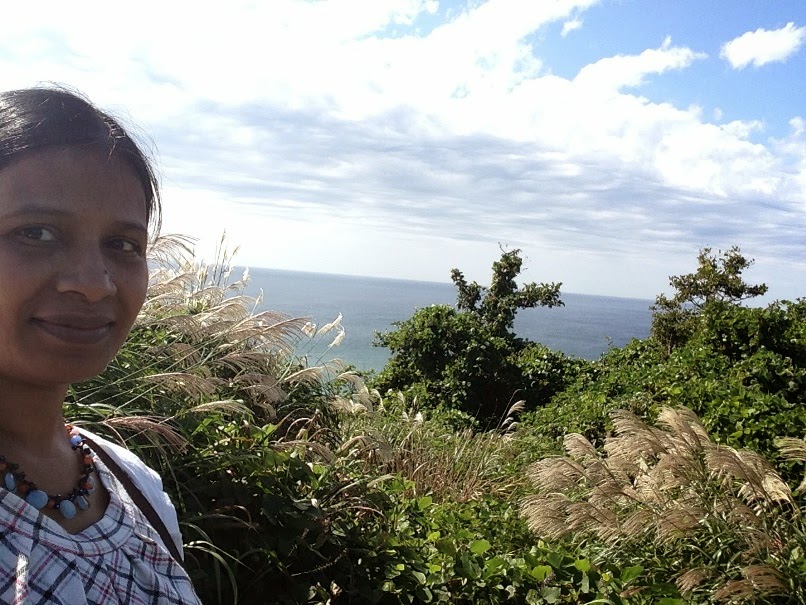
Myself along with the blue sea and elegant plumes of Susuki grass


Next, we walked towards the west side of the flat hilltop of the park. There we saw an observatory having two floors. From both the floors of the observatory, we can get 360-degree panoramic view of the beautiful sceneries of the area. A strikingly huge statue of Kannon stands on the second floor of the observatory overlooking the sea. We skipped going to the first floor and directly went to the second floor of the observatory, and enjoyed the gorgeous scenery all around us. We loved viewing the splendid Mount Chokai and the magnificent Sea of Japan from the observatory. The interesting point is that Mount Chokai located towards the south-southeast and the Sea of Japan located towards the west side can be seen at the same time while standing at the south side of the observatory. In fact, we enjoyed some of the best scenic views of the area from the second floor of the observatory.
I am walking towards the observatory located at the top of the hill of the park

Two-floor observatory

Mount Chokai (left) and the Sea of Japan (right) as viewed from the south side of the second floor of the observatory

Mount Chokai and the windmills

I am enjoying seeing the sea standing at the west side of the second floor of the observatory

Beautiful view towards the north side

I am standing at the north side of the second floor of the observatory

Hubby and the beautiful views

Huge state of Kannon


While strolling in the park, we saw a few fauna of the area. We saw two types of spiders, a grasshopper, a swarm of dragonflies, and even a snake. Hubby took photos of several of the fauna. And I took a few photos of hubby who was busy clicking away with his camera.
Hubby clicking a photo of a spider

The spider

Another type of spider

Hubby clicking a photo of a grasshopper

The grasshopper

Oh the dragonfly flew away!

Again clicking a photo of another dragonfly

Hubby exclaimed - ah this time I got you dragonfly!


We enjoyed our visit of Hamadate Koen Park. It was a sunny day and the scenic views that we saw from the top of the hill of the park were fantabulous.

Sunday, November 17, 2013

Tottori Sand Dunes

As I wrote in the post before the last one, on the morning of August 12th, hubby and I visited Amanohashidate Chionji Temple in Miyazu City of Kyoto prefecture. In the afternoon, we visited Tottori Sand Dunes which are the largest sand dunes in Japan. These sand dunes are breathtaking and beautiful natural formation located near Tottori City in Tottori prefecture. The dunes are actually located just outside the city center and are the most famous tourist attraction of the city. Stretching along the coast east of the city, the dunes span roughly 16 kilometers of the coast from east to west along the Sea of Japan, and are about 2.4 kilometers wide from north to south. However, the main portion of the dunes is much smaller and spans only about 2 kilometers from east to west, but are still very impressive. Technically the sand dunes are not referred to as desert because the area receives a lot of rainfall, and also there is Sea of Japan adjacent to the dunes. However during summer, the temperatures in the sand dunes can rise up to 60 degrees Celsius. These sand dunes are part of Sanin Kaigan National Park, and have been designated as a Natural Monument of Japan.


Tottori Sand Dunes are magnificent artwork created by nature over 100000 years ago. The dunes were created by sediment deposits carried from Chugoku Mountains by Sendaigawa River into the Sea of Japan. Eventually, sea currents and wind brought the sand from the bottom of the sea onto the shore, which gradually accumulated and re-deposited along the coast over a long period of time. And as a result, the sand dunes were formed. Today, the constant movement of the tides and the strong coastal winds continuously rearranges the shape of the sand deposits and create incredible desert-like formations. At times, 40 meters deep basins, 50 meters tall hills, wind ripples, and sand sliding down the surface of the hills like an avalanche can be seen. The highest dunes reach around 90 meters above sea level, and because of the rains they can have slope of up to 40 degrees steep. The best time to view the sand dunes is early in the morning before other tourists track up or trample the sand. We can see the beautiful wind ripples and other unique patterns carved by the wind.


It is unfortunate that the area of the sand dunes is steadily shrinking due to a government reforestation program after World War II. In addition, concrete barriers erected to protect the coasts from Tsunami have disrupted the sea current responsible for bringing the sand to the shore. Encroaching weeds and patches of crabgrass keep sand from moving freely and the sand ripples from forming. Recently local government has adopted several measures to stop the shrinkage of the dunes.


The main sightseeing area at the sand dunes spans about half a kilometer between the visitor center and the sea coast. Many of the largest sand dunes are found here, and their tops provide visitors with beautiful views out over the coast. The place can be nicely explored by climbing up the dunes. There are also a number of other attractions to enjoy around the dunes. A tour on the back of a camel or in a horse drawn cart can be very interesting. In addition, the dunes can also be enjoyed from Dune Observatory Center, which is connected with the sand dunes by a chair lift. In addition, adventurous activities like paragliding and sand-boarding opportunities are also available.


On August 12th, first we visited Amanohashidate Chionji Temple in Miyazu City of Kyoto prefecture. After that we visited Tottori Sand dunes in Tottori City. The sand dunes are located about 120 kilometers west of Chionji Temple, and it took us about 2 hours and 30 minutes of car ride to reach the sand dunes. We parked our car at the parking area of a souvenir shop. This souvenir shop is located right in front of one of the southern entrances to the sand dunes. At the entrance area, about 100 meters to our right side, we saw chair lift that took visitors right above the sand dunes. However, we decided to walk on the sand dunes.
I am standing near one of the southern entrances to the sand dunes

Chair lift taking visitors right above the sand dunes


After passing through the entrance area, we were surrounded by sand all around us. That area was more or less flat but we found it a bit difficult to walk. This is probably because we were walking on the sand for the first time. It took us some time to get used to, but we soon realized that walking on the sand was actually fun. As I have mentioned earlier, the main sightseeing area of the sand dunes spans about 2 kilometers from east to west and are about 0.5 kilometers wide from north to south. We entered the area from the south and aimed to climb one of the tallest hills of the sand dunes located towards the northern end. We started walking towards the north and it seemed almost surreal to see the sand dunes spread out in front of us like a real desert. After walking for several tens of meters, we saw a few camels to our right side. Many people were enjoying the camel rides and touring the sand dunes.
Vast expanse of sand dunes to our left side

View of the sand dunes right in front of us. We aimed to climb the hill marked with red arrow.

The sand dunes and I

Hubby and the view of sand dunes to our right side

Visitors touring the sand dunes riding on the back of camels

A kid enjoying the camel ride


After about five minutes of walking on the flat area of the sand, we started getting the feeling that we were climbing uphill although the area still seemed more or less flat to our eyes. After walking for just five minutes on such an uphill area, we already started feeling a bit tired and could actually feel our muscles working harder walking on the sand. So we slowed down our pace of walking a bit. We were walking on the sand at about 1 pm in the afternoon of a very bright sunny day during peak summer time. It was blazing hot but it was still fun to walk on the boiling hot (felt like that) sand dunes. I had a digital thermometer with me and tried to check the temperature of the sand but it was just 37.4 degrees Celsius. I read in a sightseeing pamphlet that the temperature in the sand dunes can rise up to 60 degrees Celsius, and I am wondering how it would feel like walking on such hot sand.
I am touching the hot sand with hands

The sand dunes to our left side as viewed from the beginning of the uphill section of our route on the sand dunes

View of the sand dunes right in front of us

View of the sand dunes to our right side

Digital thermometer showing the temperature of the sand dunes


After walking uphill on the sand for another five minutes, we took rest for some time. We clicked a few photos of us for the sake of memory. While taking rest, I realized that it was a summer afternoon during the peak holiday season in Japan (Obon holidays). From early morning onwards, many tourists had started visiting the sand dunes that day. So as I expected, the tourists had completely tracked up or trampled on the sand. And there were no beautiful wind ripples or other unique patterns carved by the wind for us to see. Nonetheless, the sand dunes were still impressive and magnificent.
View of the sand dunes in front of us

Hubby and the sand dunes

We and the sand dunes


While walking on the sand further up the hill on such a hot summer afternoon, we realized that how easily we can get tired. Hubby was sweating a lot. So after another five minutes of walking, we again took rest for some time and drank a sports drink to keep ourselves hydrated. From this point where we rested, the highest hill of the sand dunes and other surrounding hills could be clearly seen, and it was truly a spectacular sight to behold. Feeling refreshed after taking rest for a couple of minutes, we put all our energy into climbing up to the top of the highest hill. These last five minutes of walking on the sand up the steep incline of the highest hill was the most difficult part. In fact, it felt like quite an achievement to reach the top of the highest hill. Conquering the sand dunes took a lot of strength but it was worth it. Everything seemed so impressive and magnificent from the top of the hill. Standing at the top, I realized that it had taken us about 35 minutes of walking, resting, and climbing uphill to reach the top of the sand dunes.
Panoramic view of the sand dunes

Panoramic view of the sand dunes from a slightly different angle

I am posing while climbing uphill

Hubby drinking sports drink

Hubby almost reached the top of the highest hill of the sand dunes

The last few minutes of climbing uphill on the sand were the most difficult part

Hubby very happy on reaching the top of the highest hill of the sand dunes


Standing at the top of the highest hill of the sand dunes, we felt a sense of freedom and oneness with nature. Looking eastward, westward, and southward from the top of the hill, the landscape of the sand dunes looked desert-like and we could see vast expanses of sand in almost every direction. But looking northward from the hilltop shattered the illusion of being in a desert as we saw the Sea of Japan spread in front of us. The sea by itself looked superb and enchanting, and we felt the cool breeze coming from the sea. The blue waters and crushing waves of the sea seemed to call us down from the slopes. But we resisted the temptation as it would have been too bothersome to walk on the sand for another hour in such hot weather conditions. Anyway, we thoroughly enjoyed the boundless view of sea and sand.
View of the sand towards the south (landward view) as viewed from the top of the highest hill of the sand dunes

View of the sand and the Sea of Japan towards the west as viewed from the top of the hill

View of the sand and the sea towards the north-northwest

View of the sand and the sea towards the north-northeast

View of the sand and the sea towards the east

Hubby standing at the top of the highest hill of the sand dunes

Hubby and I standing at the top of the hill


We stayed at the top of the highest hill of the sand dunes for about ten minutes. But then it was time to go back down the hill again. It was quite a strain and hubby seemed rather unwilling. We went a little offside towards the west, and started walking down the hill. On our way, we saw a few people paragliding down the slopes. Hubby joked that we should also do the same. But unfortunately, we are not into any kind of adventure sports activities. While walking down the hill, we noted that crowds of young people were speed-running down the sandy slope. We also followed their example, but midway down the slope my shoes were filled with boiling hot sand because of running down the hill. The scorching hot weather and the sizzling hot sand in my shoes made me dizzy but somehow I did not faint. We reached the bottom of the highest hill of the sand dunes in just eight minutes. We walked for another couple of minutes on the flat area of the sand near the southern end, and turned around to click final few photos of the sand dunes.
Hubby standing at the top of the highest hill of the sand dunes and seems very reluctant to go back down

Walking down the hill

I was tired and sat down on the hot sand on our way down the sandy slope

A tourist (encircled and shown enlarged) enjoying paragliding

We could see the western edge of the highest hill while walking down its sandy slope

Hubby walking down the slope

I am walking down the slope (hubby clicked this photo from above)

On reaching the flat area of the sand near the southern end, we turned around and saw the vast sand dunes in front of us as viewed in this photo

View of the sand dunes to our right side


Our digital thermometer indicated that the temperature had risen by just 0.5 degrees Celsius in the past fifty minutes. However, because of all the walking, climbing, and running on the hot sand, we felt the apparent temperature to be much higher. After enjoying walking on the hot sand of the dunes, we walked up to the camel riding zone and took rest under the shade of a tree for some time. We clicked a few photos of us with the camels. Afterwards we left the sand dunes, and went to a souvenir shop located right in front of one of the southern entrances of the sand dunes. We bought cute sand models of letters ‘K’ and ‘M’ which represent the first letters of hubby’s (Kazuo) and my (Manisha) first name.
Digital thermometer showing the temperature of the sand dunes

Hubby and a camel

I am standing next to a sitting camel

Sand models of letters ‘K’ and ‘M’ as souvenirs


Hubby and I really enjoyed visiting Tottori Sand Dunes. The sand dunes seemed like a mini-desert and I imagined that we were walking in the Arabian Desert. It was a nice and unique experience. In the evening we visited Hakuto Shrine in Tottori City itself. I will write about it in the next post.