Showing posts with label Yokote. Show all posts

Sunday, February 19, 2017

Akita Furusatomura

One of our friends living in Akita City will be leaving Japan soon. He is an Indian working on a time-limited research project at Akita University in Akita City. Hubby and I met him and his family for the first time in 2014 and we were very happy to meet an Indian family in faraway northern Japan where foreigners are still a rare sight. His family left for India before the winter season probably to avoid the severe cold of Akita. On 11th February, hubby and I hosted a farewell dinner for him at a Nepalese restaurant named Namaste located in Akita City. The restaurant serves Indian as well as Nepalese food. We invited another Indian couple also. We all enjoyed having various kinds of Indian dishes for dinner and it was fun recalling the nice time we had over the last couple of years. We wish him good luck and best wishes for his future endeavors.
Our friend (middle) soon to leave Japan

We all having dinner at a Nepalese restaurant


While having dinner, I remembered about hubby and my trip to a sightseeing place called Akita Furusatomura with our Indian friend who is leaving Japan. It was way back in July 2016, and his wife and young son also had accompanied us. I had completely forgotten about that trip and therefore thought about writing a blog post about Akita Furusatomura today. Akita Furusatomura is located in Yokote City of Akita prefecture. It is an amusement theme park where we can play and learn. The park has various facilities like the Akita Museum of Modern Art, the Wonder Castle, a planetarium, and an exhibition and demonstration of traditional handicrafts facility. In the theme park, we especially focused our visit to the Wonder Castle, which features trick art and indoor playground fun for kids.


On the morning of 16th July 2016, hubby and I first went to Akita City by our car where we picked up our Indian friend and his family and then went to Akita Furusatomura in Yokote City. Akita Furusatomura is located about 75 kilometers southeast of Akita City and is situated near the Yokote junction of the Akita expressway. It took us about 1.25 hours of car ride to reach Akita Furusatomura. We parked our car at a parking lot located outside the theme park. On entering inside the theme park, first we took a ride on a bright red colored train type bus named Choo Choo train. It is very popular with kids and we thought that our friend’s son would like it. We bought 4 tickets each worth 410 Yen for the adults and another ticket worth 200 Yen for the kid for the bus-train ride. When the bus-train started moving we felt the pleasant breeze and enjoyed the short journey inside the theme park. As the bus-train moved along the route, adults as well as children became curious and started wondering out loud about various buildings, play area for kids, and many statues along the way. Fortunately a train guide announced the salient features of each facility in an easy-to-understand manner. It was a fun ride.
Hubby fastening the seatbelt of the son of our Indian friend before starting on our car ride to Akita Furusatomura

Our friend’s wife and son inside Choo Choo train at Akita Furusatomura

I am enjoying the Choo Choo train ride


Next, we went to Akita Museum of Modern Art but decided not go inside the museum building as we thought that the 3-year-old kid will not find it interesting. So we all strolled outside the museum building for quiet some time. It was a cloudy day but we enjoyed the walk surrounded by many huge outdoor statues. I found three statues to be very interesting. One of them was named Koeyoshidori, which is a long-crowing chicken breed of Akita prefecture and is designated as a national treasure of Japan. The statue was sculpted by Aikawa Zenichiro in 1952. It is 1.1 meters high and looks majestic and cheerful. The second statue was named Daichi no Kodo which was sculpted by Ando Izumi in 1993. It is a statue of a huge mammoth and measures 3.5 meters high. This statue was constructed using forged copper plates by hammering them several thousands of times. The third set of statues was named Inu mo Arukeba. This set of statues was sculpted by Yabuuchi Satoshi in 1993. All the statues in this set are 79 centimeters high and is a playful work with the motif of Akita dogs. This set of statues has a sense of continuity as if a dog is walking. Children as well as adults enjoy riding them. We enjoyed taking a stroll outside the museum building and took several photos of us with a few of the statues.
We all are strolling outside the museum building in Akita Furusatomura

Hubby, our friend and his son enjoying a walk

Hubby and our friend’s son enjoying a walk

Statue of Koeyoshidori as viewed from two different angles

Our friend and his family standing in front of the statue of a huge mammoth

Hubby and I standing in front of the mammoth

We all enjoyed riding the statues of Akita dogs

Hubby sitting on a statue of Akita dog and clicking photos


Afterwards we temporarily left Akita Furusatomura premises to have lunch at a Nepalese restaurant located about 8 kilometers south of the Furusatomura. The restaurant serves Indian as well as Nepalese food. We enjoyed having various kinds of Indian dishes. Hubby especially loved having cheese Naan which came with his set menu. We were quite full and satisfied with the lunch. After lunch, we returned to Akita Furusatomura and entered the local handicrafts, food, and gift shops. It was nice to look at all the handicrafts but we did not buy anything. In addition, we skipped visiting the planetarium as there was not enough time to visit all the facilities of Akita Furusatomura that day itself.
My lunch that I had at a Nepalese restaurant located in Yokote City

Hubby’s lunch set

Hubby enjoying having Cheese Naan

Our friend and his family enjoying lunch

I am standing with our friend’s wife and son inside the local handicrafts, food, and gift shop at Akita Furusatomura


Next we visited Wonder Castle building located inside Akita Furusatomura premises. Wonder Castle has an exhibition of illusion type pictures and a lot of trick arts. This place is ideal for kids as well as families. At the first floor entrance area of the building, we bought tickets worth 520 Yen for the adults and it was free for the kid. First we went to the fourth floor of the building and enjoyed being inside the Mirror Room and the Giant’s Room. Next, we saw a wonderful trick art area named ‘The World above the Clouds’ where we enjoyed ‘balancing’ ourselves while coming out of a castle located amongst the clouds. We also enjoyed flying like a bird amongst the clouds in this area. Then we went inside the Slanting Room also located on the fourth floor. It is a gravity hill type distorted room that is used to create tilt-induced visual illusion. We really loved this room where the rules of gravity did not seem to apply as we expect them to. Once we stepped inside this room, we felt as if we had abandoned all sensations of balance, proprioception, and general physical stability. Thanks to the architectural trickery, it felt as if we could tilt our bodies unrealistically in this room. We loved being in this room and it is no wonder that the Slanting Room is the most popular corner of the Wonder Castle. Afterwards we went to the third floor of the building where more trick arts and optical illusions were present. We enjoyed tightrope walking, cage for human, pulling a portable Mikoshi Shrine, and Ames Room at this floor. I loved the optical illusion of the Ames Room very much where hubby standing in one corner of the room appeared to be a giant while I standing in the other corner appeared to be a dwarf to the our friend photographer standing outside the room. The illusion was so convincing that hubby walking back and forth from the left corner to the right corner appeared to grow or shrink. It was really impressive optical illusion. At this point, the exhibition of various trick arts and optical illusions were over. We adults enjoyed looking at various trick arts and loved the place more than the kid. I guess we adults are still kids at heart!
Our friend’s wife and I inside the Mirror Room

I am standing inside the Giant’s Room

We are the food for the Giant

We are ‘balancing’ ourselves while coming out of a castle located amongst the clouds

I am flying amongst the clouds

Wondering how hubby can tilt his body so much inside the Slanting Room

Well, I can tilt my body too

I am a tightrope walker

I am inside a cage for human

I am pulling a Mikoshi Shrine

Hubby is a giant and I am a dwarf inside Ames Room

Our friend and his family inside Ames Room


Afterwards we returned to the first floor inside the Wonder Castle building where we saw a giant ball pool. Our friend’s kid became very excited seeing the ball pool filled with colorful balls. The kid, his mother, and I had so much fun playing in the ball pool. We spent about 40 minutes at the ball pool. The amusement park closes at 5 pm and so the kid very reluctantly left the ball pool area where he seemed to have maximum fun.
I am playing in the ball pool

I am playing with the kid in the ball pool

The kid, his mother, and I having fun in the ball pool

Tired hubby and our friend taking rest while we played in the ball pool


We all had a nice time at Akita Furusatomura and left the premises at about 5 pm. We then took our friends back to their home in Akita City. It was about 7.30 pm when we returned to our home in Yurihonjo City. It was a fun filled outing with friends.


Wednesday, April 24, 2013

Kamakura Snow Festival

On 16th February, hubby and I went to see Kamakura Snow Festival in Yokote City of Akita prefecture. The Snow Festival is held annually on 15th and 16th February. Yokote City lies in an area of heavy snowfall where 20 to 30 centimeters of snow falls overnight during winter. This abundant snow is used to build small igloo-like structures called Kamakura made entirely from compacted snow. About 100 full-size Kamakuras and 10000 mini-Kamakuras are built prior to the festival days. The festival site looks so wonderful during the festival days.


Kamakura Snow Festival has been celebrated for more than four hundred years. The festival is held during the lunar new year together with other seasonal events such as the festival where pine and rope decorations used at the previous new year celebrations are burned in a sacred bonfire, a ceremony to pay homage to the god of water, and a ceremony to pray for an abundant harvest. In the past there have been water shortages in this region, and that is why prayers are offered to the water deity enshrined inside the Kamakura. Originally, Kamakuras were rectangular and had wooden roofs. Now they are constructed entirely of snow and are more dome-like. Each Kamakura is about 1.5 meters wide and 2 meters tall. They are constructed by piling snow, trampling it, packing it down, and then allowing it to freeze and harden over the course of about a week. The hardened mounds are then hollowed out to make a roomy chamber. A small entrance gives access to the wide space inside. An altar for the water deity is carved into the rear of the room inside the Kamakura. The floors are covered with grass mats and many Kamakuras are equipped with a single light bulb hanging from the ceiling to provide illumination. A charcoal brazier at the center of the Kamakura is used to grill Mochi and heat Amazake, and the visitors enjoy having them sitting inside the snow hut in the cold winter.


About 100 full-size Kamakuras are built by the townspeople prior to the festival days. In addition, children also participate in making and decorating the riverbanks and roadsides with about 10000 mini-Kamakuras. At night, candles light up the Kamakuras and mini-Kamakuras which produce beautiful spectacle. There are seven main festival locations in Yokote City. Doro Koen Park, the area around Yokote Regional Departments (Yokote Chiiki Kyoku Mae) is the main event area. Haguro-cho and Futaba-cho are the more historical Kamakura sites. The area around Yokote Castle is popular for its view. Hundreds of mini-Kamakuras are built at Janosaki Kawahara as well as at the area in front of Yokote Minami Elementary School. ‘Love Kamakuras’ are built at Yokote East Nigiwai Hiroba area. We visited the snow Kamakuras at Doro Koen Park area.


On 16th February, hubby and I left our home at about 10 am to go to Kamakura Snow Festival. Since it was snowing rather heavily that day, hubby had to drive our car very slowly due to poor visibility and icy road conditions. While driving, we saw blankets of heavy snow all around us. The festival area is located right on the Akita Expressway and it took us about 1.5 hours to reach the site. It took another 30 minutes to find a car parking area as almost all parking lots were full that day because of many visitors to the festival site. From the parking area, we walked for about fifteen minutes to reach the festival location. While walking, we saw huge amount of snow piled up on the sidewalk. But the sidewalk was rather wide and we could walk easily.
While driving, we saw snow piled up on either side of the road

Snow everywhere around

Snow piled up on the sidewalk leading to the festival site

Torii Gate of a temple or a shrine on our way to the festival site


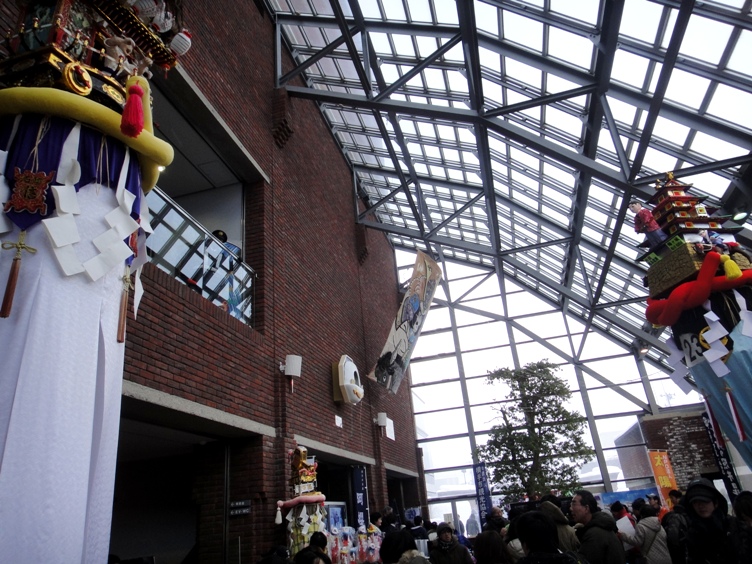
First we went to Yokote Fureai Center Kamakura House, which is located very near to the festival main event area. The lobby of this building has a vast space where several Bonden were displayed that looked so beautiful. Bonden is a sacred wand of Shinto deities measuring about five meters in length, and has ornamental decorations atop the Bonden pole. Every year Bonden Festival is held in Yokote City on 16th and 17th February. On the 16th, various neighborhood associations dressed in festival attire hold a parade in the downtown area. On the 17th, the neighborhood associations carry the Bondens in a stately procession to Asahiokayama Shrine. In fact on the day we visited, that is on 16th, we saw several groups with their Bonden. But we did not see any parade probably because there was a snowstorm in the city that afternoon. Anyway, we enjoyed viewing several Bonden displayed inside Yokote Fureai Center building. From the second floor of the building, we could see Kamakura snow huts at Doro Koen Park area.
I am standing near the entrance of Yokote Fureai Center building

Lobby near the entrance of the building

A Bonden

Another Bonden

Kamakura snow huts at Doro Koen Park area as viewed from the second floor of the building

More Kamakuras at the park area as viewed from the second floor of the building


After coming out of the Yokote Fureai Building, we walked a couple of steps north, crossed a big road at a traffic light junction, and reached the central area of the rectangular Doro Koen Park. First we walked towards the eastern side of the park and then towards the western side. I have drawn a schematic figure that explains the five routes R1 to R5 along which we walked and enjoyed viewing Kamakuras and mini-Kamakuras. Some of the routes are the same but are in the opposite direction. It was snowing heavily on and off and I felt that the snow huts looked different under different weather conditions.
Figure explaining the five routes R1 to R5 in Doro Koen Park along which we walked and enjoyed viewing Kamakuras and mini-Kamakuras


First we walked on Route 1 towards the eastern side of Doro Koen Park. We saw many Kamakura snow huts in a row but the entrance of all of them faced east, and so we saw the back side of the huts as we walked along the route in the park. It was snowing heavily that time, and the snow covered trees and the park looked brilliant. On our way, we entered inside one of the huts and observed the details. We walked leisurely for about 20 minutes, and came to the end section of this route where a huge Kamakura hut was built and a mushroom animation character named Nameko was sculpted.
Kamakuras in Route 1 of the park

I am standing in front of a Kamakura

Hubby standing inside the Kamakura

Snow covered park, trees, and Kamakuras

End section of the route

A huge Kamakura and a sculpture of Nameko at the end section of the route


On reaching the end section of Route 1, we turned around and walked in the opposite direction on the same route. This route towards the west is Route 2 in the park. Again, we enjoyed viewing the Kamakura huts built in a row. But on this route, we saw the front side of the huts as we walked towards the west. It was snowing very heavily that time, and the snow covered trees and the park looked almost surreal in the snowstorm. We entered inside one of the Kamakura huts for a couple of minutes to avoid the strong icy wind. Once the weather improved a bit, we continued our walk along the route.
Snow covered park, trees, and Kamakuras in Route 2 of the park

I am standing in front of a Kamakura when it was snowing very heavily

I am standing inside the Kamakura to avoid strong icy wind

Kamakuras in Route 2 of the park


While walking on Route 2, we saw a wonderful snow structure to our right side towards the northern section of the park. This snow structure was built in an open space which is actually the car parking lot of a real estate company named Top Realtor. The huge sculpture was a roofless shrine with artistically sculpted surrounding snow walls. About 1108 snow-hollowed alcoves were carved throughout the outside as well as the inside of these walls of the shrine. The walls were rather thick and hundreds of mini-Kamakuras were built on the top of the walls. In the night time thousands of lit candles adorned the mini-Kamakuras and alcoves in the wall. Inside the shrine compound, a snow sculpted altar of water deity was located at the center of the complex. In the heavy snowfall, we had some difficulty in seeing the altar properly. This huge snow shrine structure was really beautiful.
The front wall of the roofless shrine structure

I am standing near the entrance of the shrine. Note that the alcoves are carved throughout the snow wall.

Inside the shrine compound

Hubby standing in front of the altar of water deity


Afterwards we continued our walk on Route 2 of the park. We saw many mini-Kamakuras built in the center of the path. We were feeling rather cold due to the heavy snowfall but we continued our walk and enjoyed viewing the Kamakuras built in a row. We loved viewing the picture perfect snow covered park, trees, and Kamakuras. After leisurely walking for about 30 minutes on Route 2, we reached the end section of this route. It was the same point in the park that was the beginning of Route 1. I again entered inside the same Kamakura hut that we had earlier entered at the beginning of our walk on Route 1. Somehow I loved this fantastic yet simple and elegant Kamakura hut.
Mini-Kamakuras in the center of the path

Hubby wondering about the heavy snowfall

Hubby feeling very cold

Snow covered park, trees, and Kamakuras

I am standing in front of the same Kamakura hut that I had earlier entered at the beginning of our walk on Route 1

I am standing at the entrance of the Kamakura

Water deity alter inside the Kamakura

I am standing next to the water deity inside the Kamakura


Next we walked on Route 3 towards the western side of the rectangular park. Here also we saw many Kamakura snow huts in a row. And because the entrance of all of them faced east, we saw the front side of the huts as we walked along the route. In addition, there were three rows of mini-Kamakuras to our right side towards the northern section of the park. All of a sudden it had stopped snowing and we could see the clear sky. The Kamakura huts looked so mystifying with the sunlight shining on them.
Kamakuras and mini-Kamakuras in Route 3 of the park

Kamakuras and mini-Kamakuras further along the way

I am standing next to the mini-Kamakuras

Many Kamakuras along the way


Near the end of Route 3, towards our right side we saw a huge park named Komyoji Koen Park. This park area was dedicated to snow art sculptures. A lot of snow had piled up in the park due to heavy snowing. But there were several wonderful art sculptures in the park that were very impressive. We entered Komyoji Koen Park through the southern end. To our left side towards the western end of this park, we saw an elegant Kamakura hut. Right in front of us towards the northern end of the park, we saw the largest art sculpture of a deity named Daikokuten. Daikokuten is one of the seven gods Shichifukujin of good fortune. We also saw a cute sculpture named Bary-san which is a famous mascot character of Imabari City in Ehime prefecture. We saw yet another cute sculpture of an animation character named Totoro. At the rightmost area towards the eastern end of this park, we saw another Kamakura hut. It had stopped snowing completely and we loved viewing all these fantastic art sculptures in such a beautiful and cold weather.
A Kamakura hut to our left side in Komyoji Koen Park

Hubby standing in front of the Kamakura

Snow sculpture of Daikokuten

I am standing in front of the sculpture of Daikokuten

Snow sculpture of Bary-san

Snow sculpture of Totoro

I am standing in front of a Kamakura hut located at the rightmost area of the park


Afterwards we exited Komyoji Koen Park and walked up to the western end of Doro Koen Park which was also the end section of Route 3. It took us about 45 minutes to view the Kamakuras along Route 3 and the snow sculptures in Komyoji Koen Park. At the end section of Route 3, we turned around and walked in the opposite direction on the same route. This route towards the east is Route 4 in the park. Again, we enjoyed viewing the Kamakura huts built in a row. It had started snowing again, so we hurried a bit and in just 10 minutes reached the end section of Route 4, which was also the starting point of Route 3.
We turned around and faced west to take this photo of Kamakuras while walking on Route 4 of the park


Next we walked on Route 5 towards the eastern side of Doro Koen Park. This Route is exactly the same as Route 1 but I just gave it a different name for simplicity. This time, it was not snowing as heavily as during the Route 1 course, so we wished to enjoy walking on the same route once more. On our way, we entered inside one of the huts and observed the details. I compiled a video of our walk on Route 5 (and Route 1) as well as the details of the outer and inner view of one of the Kamakura huts. It took us about 20 minutes to leisurely walk up to the end section of Route 5. This time we crossed a big road at a traffic light junction at the end section of the route, and took photos of the remarkably big Kamakura hut and the sculpture of animation character Nameko.
Hubby standing in front of a Kamakura hut in Route 5 of the park

Hubby sitting inside the Kamakura

A compiled video of our walk on Route 5 (and Route 1) as well as the details of the outer and inner view of a Kamakura hut

We turned around and faced west to take this photo of Kamakuras while standing at the end section of Route 5 of the park

Hubby standing next to the huge Kamakura hut at the end section of the route

Hubby standing in front of the sculpture of Nameko


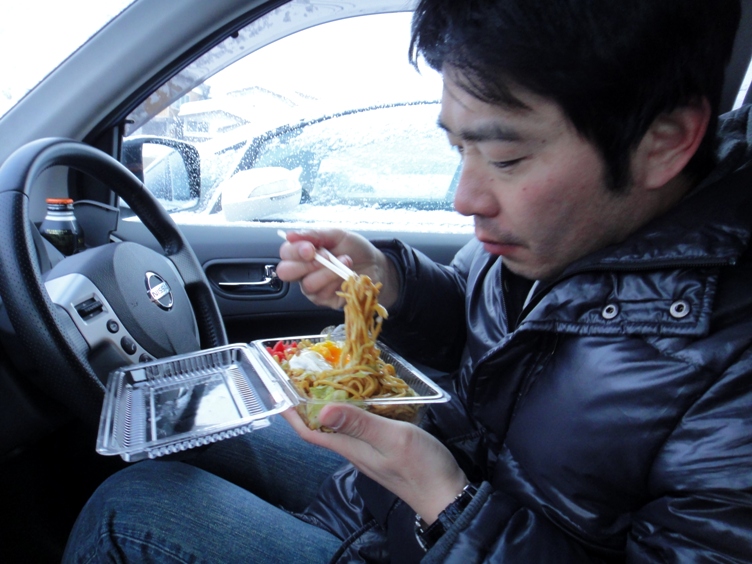
Afterwards we left Doro Koen Park and went to the food stalls area located in front of Yokote Fureai Building. The stalls served various kinds of Japanese festival food. We bought two bento (lunch) boxes of Yokote Yakisoba and sausages. We ate them inside our car as there were a lot of customers and there was no space left to sit and eat the delicacies in the food stalls area.
Entrance of the food stalls area

Food stalls

Yokote Yakisoba

Hubby eating Yakisoba inside the car


Although it was an extremely cold day, we enjoyed the Kamakura Snow Festival very much and had a nice time. We left the festival site at 4 pm and returned back home in about two hours.