Showing posts with label Shirakawa-go. Show all posts

Sunday, July 12, 2015

Shirakawa-go - part 2

This post is in continuation to the previous post about our visit to the scenic historic village of Shirakawa-go located in Shogawa River valley at the foot of Mount Hakusan in the northwestern part of Gifu prefecture. Shirakawa-go is famous for its traditional Gassho-zukuri architectural style farmhouses, some of which are more than 250 years old. Gassho-zukuri architectural style means ‘constructed like hands in prayer’, as the farmhouses are characterized by thatched and steeply slanting roofs resembling two hands joined or pressed in prayer. The largest village and the main attraction of Shirakawa-go is Ogimachi, which is the most popular village for the visitors. We also visited Ogimachi village. In the previous post I wrote about various traditional Gassho-zukuri styled farmhouses that hubby and I saw in Ogimachi village on 29th December 2014.


After seeing Myozenji Temple premises, we continued walking along the road towards the north in Ogimachi village. Adjacent to Kuri farmhouse building of Myozenji Temple, we saw a Gassho-zukuri styled thatched roof farmhouse named Yosobe to our right side towards the east. Yosobe farmhouse now serves as a Minshuku inn. The inn has traditional Japanese-style guest rooms where visitors can have a relaxed stay. Homemade Japanese-style food is served to the guests. We loved the architectural style of Yosobe farmhouse and took a few pictures of the building from various positions and angles.
Yosobe farmhouse Minshuku inn

Another view of Yosobe farmhouse

Hubby standing in front of the farmhouse


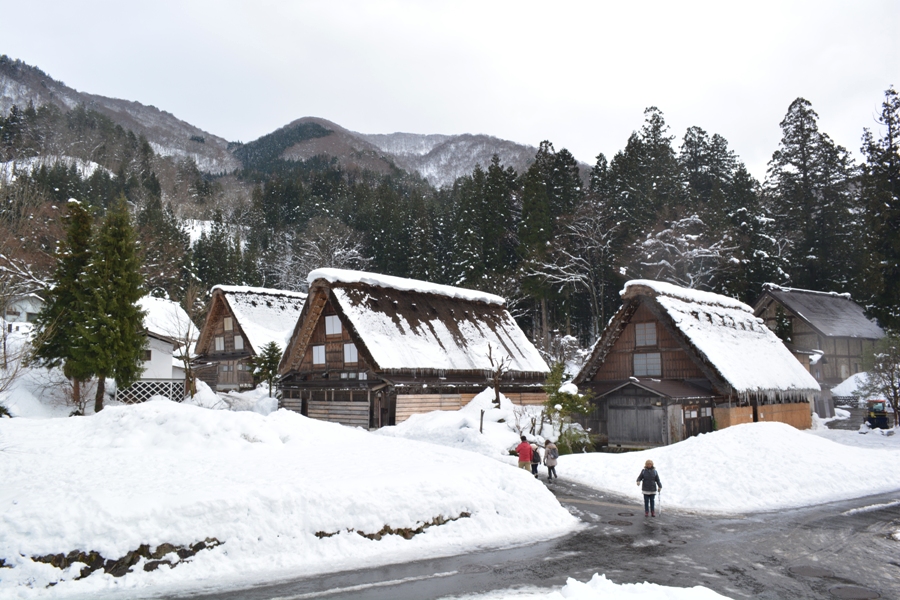
Right across the road, to our left side towards the west, we saw a small and elegant private residence farmhouse building with Gassho-zukuri architectural styled roof. We loved the snow covered steeply slanting thatched roof of the farmhouse very much.
Snow covered roof of the private residence farmhouse


Adjacent to Yosobe Minshuku inn, we saw a comparatively small Gassho-zukuri styled farmhouse named Gasshoan located to our right side towards the east. Gasshoan farmhouse now serves as a souvenir shop selling handmade local products and accessories, small bags made by the owner of the farmhouse, as well as unique local sweets and rice crackers. The farmhouse looked grand surrounded by complete whiteness of the snow. We took a few photos of the farmhouse in such a snowy landscape from different positions and angles.
Gasshoan farmhouse

Hubby is standing in front of the farmhouse. This is the side view of the building as viewed from the north.


We continued walking along the road leading towards the north, and next saw a restaurant named Sobadokoro Nomura located to our left side towards the west. It is a rather new building with normal tiled roof, which looked remarkably different in the village full of Gassho-zukuri styled buildings. Sobadokoro Nomura is a counter-type Soba noodle restaurant with only 17 seats, and so a big queue of hungry visitors is often formed in front of the restaurant. The restaurant serves homemade Soba noodles made from locally grown buckwheat ground in a homemade stone mortar and mixed with spring water taken from Mount Hakusan. The deliciously chewy Soba noodles please and satisfy many customers. We were not hungry so skipped going to the restaurant.
Sobadokoro Nomura restaurant to the left side of the photo (red arrow)


Adjacent to Sobadokoro Nomura restaurant, we saw a small Gassho-zukuri styled private residence farmhouse building. The snow covered steeply slanting thatched roof of the farmhouse looked so elegant. In addition, we saw a few scarecrow puppets in the backyard of the farmhouse. The puppets looked so cute in the backyard full of snow.
Snow covered roof of the Gassho-zukuri styled private residence farmhouse

We got an amazing view of the backside of the private farmhouse building along with a few scarecrow puppets in its backyard. The building to the right side (red arrow) is the backside of Sobadokoro Nomura restaurant.

I am standing along with the scarecrow puppets


We walked further north along the road for another 50 meters or so and saw a building named Zensuke with normal tiled roof to our right side towards the east. Zensuke serves as a souvenir shop stocked with Hida folk art, handmade crafts like key rings, and homemade rice crackers and snacks made using rice grown and harvested by the owner. We spent some time inside the shop appreciating all the local products. In addition, right across the road, we saw an interesting spot where large amount of snow was piled up to our left side towards the west. We climbed up the 4 meters high piled up snow and enjoyed the beautiful snowy views all around us for some time. Many children enjoyed riding plastic sleds down the piled up snow.
A portion of Zensuke souvenir shop (left side, red arrow) along with many people enjoying the snowy views from the top of the piled up snow (right side). This photo is clicked from the north. The Gassho-zukuri styled private farmhouse (green arrow) has the scarecrow puppets exhibited in its backyard.

We clicked a selfie from the top of the piled up snow


Standing on the top of the piled up snow, as discussed in the previous paragraph, we saw three grand Gassho-zukuri styled thatched-roof farmhouses standing elegantly towards the north. In fact, this piled up snow area is a favorite spot for photographers to shoot these three grand farmhouses. The farmhouse building located in the front is named Ochudo and now serves as a cafe restaurant. In addition, two farmhouse buildings are located slightly behind Ochudo Cafe; the one to the right side is a private residence and the other one to the left side is named Kanda ke Jutaku or Kanda House. We wished to have a closer look at the three farmhouses, so we got down the piled up snow and walked along the snowy road to explore the exterior architecture of the buildings. In the next couple of paragraphs, I will write in details about the farmhouses Ochudo Cafe and Kanda House.
I am standing next to a snowman near the piled up snow along with the three Gassho-zukuri styled farmhouses Ochudo Cafe (1), Kanda House (2), and a private residence (3) in the background

The three farmhouses as viewed from the top of the piled up snow

Enlarged view of the three farmhouses

I am standing along a snowy road. Ochudo Cafe (1) is seen to the left side and the private residence (3) is seen to the right side of the photo. A portion of Kanda House (2) is seen in the background.

Ochudo Cafe (1), the private residence (3), and a portion of Kanda House (2) as viewed from the north side while walking along the road


As discussed in the previous paragraph, of the three grand farmhouse buildings, the one located slightly in the front is Ochudo Cafe. The cafe is a 350-year old Gassho-zukuri styled deeply slanting thatched roof farmhouse and a great place to rest after strolling in the village. On entering inside the building, it is seen that the building is semi-underground. Set around a large Irori hearth, the cafe serves curry rice, green tea, coffee, and confectioneries made using natural spring water. During some special months, a Nabe pot having Zenzai soup is slowly cooked over Irori hearth, and free refills are offered to the customers in the relaxed and cozy atmosphere inside the building. We did not enter inside but appreciated the exterior architecture of Ochudo Cafe building.
Ochudo Cafe


Kanda ke Jutaku or Kanda House is a high-quality Gassho-zukuri styled picturesque farmhouse having more than 160 years of history. It is one of the best preserved farmhouses in Ogimachi and has been turned into a museum. This stately farmhouse is located in the center of Ogimachi village and visitors can get good views of the surrounding houses from the windows of its upper floors. This Gassho-style farmhouse has steep roof trusses, truly advanced room layout, and delicate carpentry work. Due to the extremely high degree of perfection in the construction of Kanda House, it is considered to be one of the top Gassho-zukuri styled farmhouses. Kanda House is a branch of Wada House that is also located in Ogimachi. Kanda House was established in the latter part of Edo period by Wada Sajiemon, the second son of Wada family. He settled here and began the linage of Kanda Family. Earlier there used to be an Ubusuna Hachimangu Shinden shrine at the location of the present-day Kanda House. The Kanji characters of ‘Shinden’ can also be pronounced as ‘Kanda’, so the son changed his family name to ‘Kanda’ in homage to the former use of the land, and later on the son came to be known by the name Kanda Kichiemon. Kanda House is estimated to have been constructed in 1850 by a master shrine carpenter from Ishikawa prefecture and it is said that the farmhouse was constructed over a period of ten years. The building is spread over four floors, and also has a mezzanine level between the first and the second floors. After establishing themselves, Kanda Family built up a Sake brewing industry at the farmhouse. The upper stories of the house were used for silkworm production, and the owners also made fuming nitric acid, an ingredient in the gunpowder of the time, as a commodity to trade for cash. Visitors cannot stay overnight at Kanda House as it is not a Minshuku inn. However, the farmhouse has now been turned into a sort of museum and visitors are allowed to enter inside and explore various floors after paying an admission fee of 300 Yen per person. We did not enter inside the farmhouse but appreciated the exterior architecture of the building.
Kanda House


We continued walking along the snowy road towards the north, and next saw a few Gassho-zukuri styled thatched roof farmhouses in a row along the road. The first farmhouse we saw is a private residence which looked so elegant and splendid in the snow. The second farmhouse is named Tanakaya and now serves as a restaurant. Tanakaya has a rustic interior and features Irori hearth. Visitors can enjoy a quite relaxed meal at the restaurant. Azuki Dango and Sansai Soba noodles of this restaurant are famous. The third farmhouse we saw is an exquisite private residence with a small barn located in front of the main house. We were very impressed to see the snow covered barn stocked with many bundles of straws. All these Gassho-styled farmhouses in the wintry snow looked so surreal.
A Gassho-zukuri styled private residence

The private residence as viewed from a slightly different angle

Farmhouse restaurant Tanakaya

Another private residence with a small barn located in front of the main house (backside)


We immensely enjoyed the slow luxurious walk along the snowy road in Ogimachi village of Shirakawa-go. However, it was too cold and hubby forgot his gloves and cap in the car. So he almost froze after about 2.5 hours of walking in such harsh wintry conditions. Although we wished to see a few more farmhouses like Wada House and Nagase House, we decided to return to the car parking lot. Hopefully we will see these farmhouses sometime in the future.

Tuesday, June 30, 2015

Shirakawa-go - part 1

As I wrote in the previous post, hubby and I visited Toyama Castle in the morning of 29th December 2014. Later in the afternoon we visited Shirakawa-go. Shirakawa-go is a historic village located in Shogawa River valley at the foot of Mount Hakusan in the northwestern part of Gifu prefecture, and is located next to another historic village named Gokayama in Toyama prefecture. In fact, these villages are typical mountain villages that are surrounded by remote mountains and forests, and stretch across the border of Gifu and Toyama prefectures. Shirakawa-go and the neighboring Gokayama villages were declared as UNESCO world heritage site in 1995. These villages are famous for their traditional Gassho-zukuri architectural style farmhouses, some of which are more than 250 years old. Gassho-zukuri architectural style means ‘constructed like hands in prayer’, as the farmhouses are characterized by thatched and steeply slanting roofs resembling two hands joined or pressed in prayer. This architectural style of the roofs developed over many generations and the design is exceptionally strong. This design in combination with the unique properties of the traditional thatching, allows the houses to withstand and shed the large amounts of heavy snow that falls in the region during winter. In addition, the roofs, made without nails, provided a large attic space used for cultivating silkworms.


Shirakawa-go is widely known as one of the most scenic places in Japan. The picturesque village feels like an old fairy tale world hidden away deep in the mountains. The largest village and the main attraction of Shirakawa-go is Ogimachi. In fact, Ogimachi is the most popular village for the visitors. The quaint settlement offers visitors the opportunity to experience the harmony between the village and nature. Ogimachi village is surrounded by pine tree-covered remote mountains. The village has many rice fields and Shokawa River runs through it. Besides the beautiful scenery of Ogimachi, the unique thatched-roof farmhouses are the center of attraction of the village. The village has 114 Gassho-zukuri styled thatched-roof Minka farmhouses that remain from historic times. Most of these farmhouses along with sheds and barns were built about 200-300 years ago, and remind us of ancient Japan. Many of these houses are still inhabited to this day, and together with their adjacent rice fields, they paint an incredibly picturesque landscape that is a joy to behold and to take a stroll through. The best way to experience the village is to stay overnight at one of the farmhouses, many of which now serve as Minshuku inn.


Hubby and I visited Ogimachi village of Shirakawa-go on 29th December 2014. We went there by our car. As we neared Shirakawa-go, we saw snow covered mountains all around us. In fact there was huge amount of snow everywhere as it was mid-winter season. First we went to Michi no Eki Travelers’ Plaza located few kilometers away from Ogimachi village. The plaza has Gassho Museum where visitors can learn about how the Gassho-zukuri houses are made. In addition, the plaza has an information center as well as local specialty and souvenirs. Unfortunately the plaza was closed due to the year-end holidays. But we liked the building architecture and took rest for some time before proceeding further on our way to Ogimachi village.
Snow covered mountains as we neared Shirakawa-go

Yet another view of the mountains

Michi no Eki Travelers’ Plaza

Our car and snow all around the plaza building

A cute poster warning people to be careful of the snow falling from roofs


Although Ogimachi village of Shirakawa-go is just 4 kilometers south of Michi no Eki Travelers’ Plaza, it took us almost 1.5 hours to reach the car parking lot of Ogimachi. This is because of severe traffic jam due to the New Year Holidays. Near the car parking lot of Ogimachi, we saw many snow covered Gassho-zukuri farmhouses with steeply slanting thatched roofs. Most of these farmhouses now serve as souvenir shops or restaurants. We felt that Ogimachi warmly welcomed us with the wonderful sight of such unique buildings in extremely cold weather. Next we walked leisurely over a pedestrian suspension bridge named Deai-bashi located across Shokawa River, and enjoyed viewing the snow covered surroundings from the bridge.
Several snow covered Gassho-zukuri buildings as viewed from the car parking lot of Ogimachi

Hubby standing in front of a map of Ogimachi area located at the car parking lot

The mountains, Shokawa River, and the pedestrian suspension bridge

People walking over Deai-bashi suspension bridge

The bridge and the river

A few Gassho-zukuri buildings as viewed from the bridge


Just after crossing the bridge, we saw a stone Torii Gate of a shrine named Akiba Jinja Shrine. We passed through the gate, and started walking along a road with Gassho-zukuri styled farmhouses scattered on either side of the road. To our right side along the road, towards the south, we saw a Gassho-style private residence and a Minshuku inn named Yoshiro. It is a homely inn for a relaxed stay and has Irori hearth for cooking as well as staying warm. To our left side along the road, towards the north, we saw several more uniquely styled buildings, like a private farmhouse residence, Binen Yumeromu Museum far in the background, and a Minshuku inn named Rihee. Binen Yumeromu Museum is 130 years old and its Gassho-style roof was renovated in 2010 after 40 years. The museum exhibits the paintings and wood carvings created by a local artist named Itadani Mineshi. We did not visit the museum this time. Rihee Minshuku inn is 400 years old and has Tsumairi Gassho-zukuri architectural style. We loved the roof of the shed located in front of Rihee Minshuku.
I am standing in front of a stone Torii Gate of Akiba Jinja Shrine

Yoshiro Minshuku inn (left) and a private residence (right)

A private residence (left), Binen Yumeromu Museum (center background) and a portion of the roof of Rihee Minshuku inn (right)

Enlarged view of Binen Yumeromu Museum

The roof of the shed located in front of Rihee Minshuku inn


We continued walking along the road towards the east, and next saw a rather new building named Ebisuya to our right side towards the south. Ebisuya is a famous souvenir shop which has Shirakawa-go related specialty products, like Hida folk art, local Sake, confectionary, and pickles stocked inside. We bought two cute wooden owls as souvenir from this shop. After several more meters of walking we saw a Gassho-zukuri styled grand looking farmhouse named Bunka Kissa Kyoshu to our left side towards the north. The farmhouse Kyoshu now serves as a cafe restaurant.
I am standing next to Bunka Kissa Kyoshu. Ebisuya building is seen on the left side (red arrow). In this photo, both the buildings are viewed from the east.

Ebisuya (left, red arrow) and Gassho-zukuri styled Bunka Kissa Kyoshu (right) as viewed from further east

A pair of cute wooden owls we bought as souvenir from Ebisuya shop


We walked further east along the road for another 50 meters or so and reached a spot where large amount snow was piled up to our left side. We climbed up the 4 meters high piled up snow and enjoyed the beautiful views all around us for some time. We saw two elegant Gassho-zukuri farmhouses to our left side towards the north. One of them is a private residence and the other one now serves as a souvenir shop named Yamaai no Ie stocked with handmade crafts, Hida folk art, and local Sake. We strolled towards the backside of the private residence and saw a small shed and a tiny pond in the backyard of the farmhouse. The snow covered steeply slanting thatched roof of the farmhouse, the shed, and the pond made for an incredibly picturesque landscape that was a beautiful sight to behold. We took several photos of the two buildings from various positions and angles.
Hubby standing on the piled up snow along with Gassho-zukuri styled Yamaai no Ie souvenir shop in the background

I am standing on the piled up snow along with the souvenir shop in the background

Gassho-zukuri styled farmhouses: private residence to the left side and Yamaai no Ie souvenir shop to the right side

Snow covered backyard of the private residence farmhouse, a small shed, and a tiny pond made for a picturesque landscape. The Gassho-zukuri styled farmhouse to the right side (red arrow) is the backside of Bunka Kissa Kyoshu.


Standing on the piled up snow, as discussed in the previous paragraph, we saw three Gassho-zukuri styled farmhouses standing elegantly in a row towards the east-southeast direction. All these farmhouse buildings looked so exotic in more than 2 meters of snow all around. These farmhouses now serve as Minshuku inn. The inn located farthest to us is named Hisamatsu which was built during the Edo period. It has 4 traditional Japanese-style guest rooms from where the guests can enjoy the view of the mountain and the village. The inn located in the middle is named Furusato. And the inn located nearest to us is named Kidoya that has 5 traditional Japanese-style guest rooms. All these inns have Irori hearth and homemade Japanese-style cuisine is served to the guests.
Gassho-zukuri styled Hisamatsu (left), Furusato (center), and Kidoya (right) Minshuku inns as viewed from the top of the 4 meters high piled up snow

Amazing view of the three Minshuku inns

Hisamatsu (center) and Furusato (right) Minshuku inns

Furusato (left) and Kidoya (right) Minshuku inns

Hubby along with Furusato (left) and Kidoya (right) Minshuku inns in the background


Standing on the piled up snow, we saw Myozenji Kyodokan Local Museum located towards the east. The museum consists of many elegant structures of Myozenji Temple, like Shoromon Gate, Hondo Main Hall, Kuri priests’ quarters, and a yew tree. Myozenji Temple is an offshoot of Jodo Shinshu Otani Sect and was founded in 1748. We wished to have a closer look at the building structures, and so we visited the temple premises. Myozenji Temple is famous for its unusual belfry-gate or the Shoromon Gate. The gate is two storied and the roof is thatched. The first floor has eaves and a bell hangs from the top of the second floor. The gate was constructed by a person named Kato Sadashichi in 1801 and about 1425 people worked to make the gate structure. The original bell was surrendered to the government during World War II, and the present bell was cast by a person named Nakamura Yoshikazu of Takaoka City in Toyama prefecture. After appreciating the gate structure, we walked past it, and saw the Hondo Main Hall of the temple right in front of us. Hondo Main Hall is unique and probably the only one in Japan having Gassho-zukuri styled thatched roof rather than the typical tiled roof seen in most temple buildings. Construction of the main hall began in 1806 when many zelcova trees were cut down for the wood to be used as construction material. It is said that the construction of the hall took about 20 years and was finally completed in 1827. The master carpenter, Mizuma Usuke, was aided by 9191 workers to build the hall. We noted that the thatched roof of the main hall was completely covered in snow and it was such a picturesque sight. I went inside the hall and prayed for the well being of my family. While going out of the temple premises, I saw a fresh green tree with snow all around it near Shoromon Gate. After the completion of the construction of Hondo Main Hall in 1827, vice-master carpenter Yoshiro planted this yew tree sapling as a memorial tree next to Shoromon Gate. The old tree brings harmony to the temple premises and is designated as a natural monument of Gifu prefecture. We came out of the temple premises and started walking along the road towards the north side. While walking, we saw a huge exotic Gassho-zukuri styled thatched-roof farmhouse named Kuri of the temple complex located adjacent to Hondo Main Hall. Kuri is the living quarters of the priests, and is connected to the main hall for easy access by the priests. Kuri was built during Edo period in 1817 by the vice-master carpenter Yoshiro. The upper floor of Kuri is open to the public where a lot of important resources and materials like tools of the local people and temple related materials are displayed. Kuri is designated as a cultural property of Japan. We did not enter inside Kuri but appreciated the exterior architecture of the building.
Myozenji Temple premises as viewed from the top of the 4 meters high piled up snow

Shoromon Gate

Hondo Main Hall of the temple

I am praying inside the main hall

An old yew tree inside the temple premises

Side view of Kuri farmhouse as viewed from the north

I am standing next to Kuri farmhouse

Kuri as viewed from further north


We continued walking along the road and saw many more interesting Gassho-zukuri styled farmhouses and stunning snow covered views all around us. I will write about the other buildings that we saw in Ogimachi village of Shirakawa-go in the next post.