As I wrote in the previous post, hubby and I stayed at Hakodate Kokusai Hotel in Hakodate City on the night on 20th June 2016. The next morning, we checked out of the hotel and visited Kanemori Red Brick Warehouse located at a walking distance from the hotel. Kanemori Warehouse is a row of red brick warehouses that were built more than a century ago at the end of the Meiji period. They are the first commercial warehouses of Hakodate. These warehouses face Hakodate Bay across a navigation channel that conjures up a feeling of nostalgia and have the atmosphere of yesteryears. The complex has its roots in the Kanemori haberdasher’s shop, which opened in 1869. The warehouses are now famous culture spots in Hakodate that attracts numerous visitors. Today they house a variety of commercial facilities and restaurants where visitors can do shopping as well as enjoy gourmet cuisine.
In 1859 Hakodate Port opened as one of the first international trading ports of Japan, along with Yokohama and Nagasaki. As the port flourished, the city saw many people and cultures come and go. Kanemori Red Brick Warehouse witnessed the history of the city through its warehousing business. As one of the symbols of the early days of the shipping industry of Hakodate Bay area, Kanemori Warehouse offers visitors an unforgettable time. In fact due to its historical importance, the warehouse area of the cityscape has been recognized as an ‘important preservation district for groups of historic traditional buildings’.
Watanabe Kumashiro founded the first warehouse business in Hakodate. He is considered to be the man behind Hakodate’s prosperity. He came to Hakodate from Nagasaki in 1863 when he was 24 years old. In 1869, he founded the former Kanemori haberdasher's shop, which now houses the Municipal History Museum. He also founded the former Kanemori ship chandlery shop, which sold imported products and ship chandlery. In addition, he engaged in many other businesses, contributing enormously to the foundation of Hakodate's prosperity. He started his warehouse business in Hakodate in 1887. The present red brick warehouse buildings were rebuilt in 1909. The view of these beautiful warehouses is certainly a must-see tourist spot.
On 21st June 2016, hubby and I left Hakodate Kokusai Hotel at about 10 am and started walking towards the Kanemori Red Brick Warehouse located just 700 meters southwest of the hotel. Ideally it should just take 9 minutes to reach the warehouse buildings but we leisurely walked along the street and enjoyed looking at various historic buildings along the way. The first building we saw was named Hakodate Beer Factory where the most impressive Hakodate Beer is brewed. The building has a restaurant inside where people can enjoy the beer. We noted that the building had a Meiji period red brick exterior and was formerly a glass-blowing craft shop. The building looked grand and nostalgic. We continued walking along the street and enjoyed the surrounding views and buildings. This street was renamed as ‘Kaiko Street’ in July 2014 to make the area more appealing to the visitors. The street connects JR Hakodate Station with the bay area and the Motomachi area. We saw many history panels and street galleries along the street. We read the history of Hakodate from such panels and galleries and felt connected to the bygone era history of the city. While walking we also saw an artistic manhole cover with a colorful image of the Orthodox Church of the Russian Consulate, one of the oldest Western-style buildings in Hakodate. Next, we saw a stately red brick building named Hakodate Meijikan located along the street. It was originally built as Hakodate Post Office Government building in 1911. The building was used as a post office and other government departments. It is one of the typical Meiji period Western buildings in Hakodate. After 50 years of usage, it was sold to a private individual in 1962. It is now used as a shopping mall where visitors can try their hand at making a musical box. We loved the exterior of the building.

I am standing in front of Hakodate Beer Factory building

I am standing next to a history panel gallery along Kaiko Street

I am standing next to another history panel gallery along Kaiko Street

Manhole cover with an image of the Orthodox Church of the Russian Consulate

Hakodate Meijikan building

Enlarged view of Hakodate Meijikan building

I am standing at the entrance area of Hakodate Meijikan building
After about 15 minutes of walking leisurely along Kaiko Street, we reached in front of Kanemori Red Brick Warehouse complex. The warehouse complex consists of four zones, each of which has its own distinctive characteristics. The fours zones are Bay Hakodate, Kanemori Yobutsukan, Hakodate History Plaza, and Kanemori Hall. These red brick warehouses are considered very valuable in Japan. The Bay Hakodate zone and the Kanemori Warehouse (which includes Kanemori Yobutsukan, Hakodate History Plaza, and Kanemori Hall zones) differ in brickwork and wood used. Now I will briefly write about these differences. Bay Hakodate was first completed in 1882 as a warehouse for the Hakodate branch office of Mitsubishi Shokai. During the early Meiji period when the warehouse buildings of this zone were constructed, the French method or the Flemish bond was mainly utilized in brickwork. This method was practiced before 1886, where long bricks and short bricks were lined alternately, producing an exquisite, elegant appearance. Non-cut Japanese cypress logs were used for all the posts and beams. Unfortunately some parts of the warehouse disappeared due to a massive fire that broke out in 1907. The warehouse was then rebuilt during 1909-1912. Since the British method or English bond method became the main popular method of brickwork during this time, the area near the roof was reconstructed utilizing the English bond. In fact, English bond method was practiced after 1886, where long-brick layers and short-brick layers were laid alternately, producing a solid, robust appearance. And it is said that the Bay Hakodate was rebuilt utilizing parts of the walls that remained after the massive fire. Next, I will write about the Kanemori Warehouse (the other three zones). The brickwork method used for the Kanemori Warehouse is the British method or English bond. These warehouses feature massive architectural structures as exemplified by the walls that are 30 to 50 centimeters thick. Heavy bricks and tiles were laid on the roof to make the buildings fireproof, which was a common practice around 1909 when these warehouses were built. To support the heavy roofs, non-cut Japanese cypress posts with a circumference of 150 centimeters were used.
First we reached in front of the Bay Hakodate zone of the Kanemori Red Brick Warehouse complex, and entered the complex through a black colored metal gate located at the southeast corner of the zone. The two red brick warehouse buildings of this zone looked amazing. As written in the previous paragraph, Bay Hakodate has an aspect different from other zones of the Kanemori Warehouse complex. Bay Hakodate warehouse buildings were first completed in 1882 utilizing Flemish bond brickwork method. The warehouse buildings were then rebuilt during 1909-1912 with the area near the roof reconstructed in the English bond brickwork method. Bay Hakodate’s symbol is a canal which was constructed in 1882 and seems to flow with timelessness. The canal now is the last remaining canal in Hakodate, and is designated as a valuable cultural property of Hakodate. A chapel, a cruising spot, and a cafe are located around the canal. Bay Hakodate is an atmospheric area that is a popular date spot for couples. We clicked a few photos in and around the Bay Hakodate area.

I am standing in front of a black colored metal gate located at the southeast corner of the Bay Hakodate zone of the warehouse complex

Hubby standing in front of a panel with historical details of the Kanemori Warehouse complex

A red brick warehouse of the Bay Hakodate zone

The red brick warehouse looks grand

Hubby standing in front of the red brick warehouse in the Bay Hakodate zone

I am standing near the canal along with two red brick warehouses in the Bay Hakodate zone

I am standing next to the canal and one of the warehouses

Hubby, the canal, and the warehouse in the Bay Hakodate zone

The canal and the other warehouse in the Bay Hakodate zone
In the Bay Hakodate area, we saw a monument which stands for the trademark logo of for the old Kanemori haberdasher’s shop. At this point, let me briefly write about the trademark logo. The trademark of Kanemori has an inverted mirror image of L-shaped character which is the symbol for carpenter’s square. It depicts faithfulness and honesty and represents the founder Watanabe Kumashiro’s motto that we need no diplomacy in business. The ‘Kane’ part of the name Kanemori represents money. The ‘Mori’ part was named after Moriya, the name of the pharmacy in Nagasaki where the founder of Kanemori Warehouse used to work earlier. The Kanji character of ‘Mori’ is written below the inverted mirror image of L-shaped character in the trademark logo. Now back to the monument. The monument is made of bricks from the Meiji period that had been used in the roof. The bricks were collected during construction work on the commercial establishment of the Kanemori Warehouse in 1988. The bricks are therefore sentinels that have witnessed a lot of history. The bell attached to the brick monument probably depicts peace. However, a bell is pronounced as ‘Kane’ in Japanese, which is similar sounding (but different Kanji character) to ‘Kane’ part (meaning money) of the trademark logo name Kanemori. So probably the bell represents peace as well as money! We noted two brick raised flower beds located on either side of the monument. The brick designs of the flower beds were based on the Flemish bond and the English bond, respectively. We loved and appreciated the simple way of depicting both the brickwork methods. Afterwards, we left Bay Hakodate zone of the warehouse complex through a black colored metal gate located at the southwest corner of the zone.
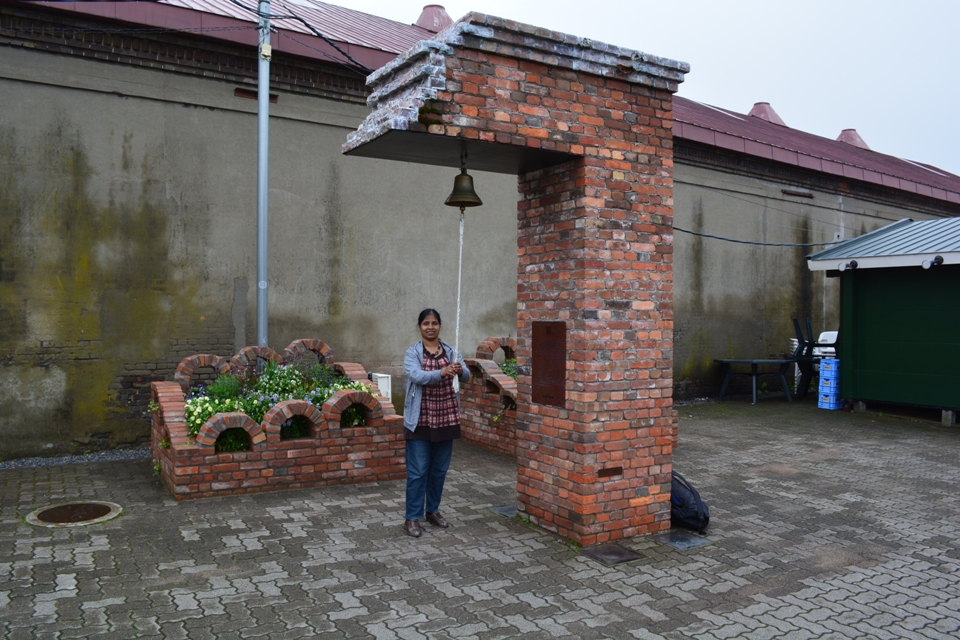
I am ringing the bell of a brick monument located at the Bay Hakodate zone. The monument represents the trademark logo of the Kanemori Warehouse.

Flemish bond designed brick raised flower bed

English bond designed brick raised flower bed

I am standing near the black colored metal gate located at the southwest corner of the Bay Hakodate zone
Next, we walked towards the north along a paved pathway surrounded by red brick warehouse buildings of the Bay Hakodate zone on one side and the Kanemori Yobutsukan zone (described later on) on the other side. It was a pleasurable stroll. We noted a few cute metal statues along the way. Hubby touched the brick layout of the warehouse building in the Kanemori Yobutsukan zone of the warehouse complex and appreciated the English bond brickwork method. He was surprised to note that at some places long-brick layers and short-brick layers were not laid alternately, but just had several long-brick layers one above the other. I guess, it is very complicated for a common person like us to understand the intricate details.

A paved pathway with red brick warehouse buildings of the Bay Hakodate zone on the right side and the Kanemori Yobutsukan zone on the left side

Side view of the warehouse building of the Bay Hakodate zone

Side view of the warehouse building of the Kanemori Yobutsukan zone

I am standing next to a few metal statues along the pathway

Hubby touching and appreciating the brickwork of one of the walls of the warehouse building in the Kanemori Yobutsukan zone
After about 2 minutes of walking along the paved pathway, we reached right in front of the port of Hakodate Bay. Facing the bay, we saw a group of red brick warehouse buildings (actually a total of five buildings) that survive from the past trading days. In fact, all these warehouse buildings aligned in a row along the waterfront form the other three zones of the warehouse complex. It was wonderful to see so many red brick warehouse buildings. All these warehouse buildings were constructed in 1909 utilizing English bond brickwork method. These warehouse buildings have recently been redeveloped into an atmospheric shopping, dining, and entertainment complex. A range of trendy souvenir, fashion, interior, and sweet shops abound at the complex. While strolling down the port area, we noted that the fronts of all the warehouse buildings had a prominent white colored mark consisting of the Kanji character for ‘Mori’ under an inverted mirror image of L-shaped character. This mark was the official trademark for the old Kanemori haberdasher’s shop.

A group of red brick warehouse buildings aligned in a row along the waterfront

The fronts of all the buildings have the official trademark (in white) of the old Kanemori haberdasher’s shop
The leftmost two red brick warehouse buildings (with respect to us facing the buildings) aligned in a row along the waterfront formed the Kanemori Yobutsukan zone of the warehouse complex. In fact these two warehouse buildings were the launching point of the Kanemori haberdasher’s shop (Yobutsuten) by Watanabe Kumashiro 147 years ago in 1869. Haberdasher’s shop used to have general goods under the rich theme of Western European lifestyle culture, and was known as the shop selling exotic dreams. With the theme of Watanabe’s rich Western culture, the Kanemori Yobutsukan zone offers a series of unique shops, like daily fun flea markets. It is packed with shops with personality and plenty of variety. It is said that this zone is a place where imported imaginative culture is gathered from across time and place. The next two red brick warehouse buildings aligned in the row formed the Hakodate History Plaza zone of the warehouse complex. This zone is home to the popular Hakodate Beer Hall which is open from around noon to 10 pm, and where visitors can enjoy fresh local beer shipped directly from the brewery. There are also a variety of other shops at this zone for the visitors to enjoy. The last red brick warehouse building in the row formed the Kanemori Hall zone of the warehouse complex. Kanemori Hall is a multi-purpose facility which is used for wedding ceremonies, concerts, and parties. We strolled down the port area and enjoyed looking at this group of red brick warehouse buildings. These elegant Meiji period buildings were a treat to the eyes. Afterwards, we entered inside one of the warehouse buildings of the Kanemori Yobutsukan zone and purchased a few souvenirs. We clicked several photos of the three zones from various positions and angles.

I am standing in front of two red brick buildings that form the Kanemori Yobutsukan zone of the warehouse complex

The Kanemori Yobutsukan zone buildings in the foreground along with the Bay Hakodate zone buildings in the background as viewed from the northwest

The Kanemori Yobutsukan zone buildings as viewed from a slightly different angle in the northwest

Two buildings of the Kanemori Yobutsukan zone in the background and two buildings forming the Hakodate History Plaza zone in the foreground as viewed from the northwest

The two buildings of the Hakodate History Plaza zone

Hubby standing in front of one of the buildings of the Hakodate History Plaza zone

Two buildings of the Hakodate History Plaza zone in the foreground and the third building forming the Kanemori Hall zone in the background as viewed from the north

Building of Kanemori Hall zone
At this point, we finished the tour of Kanemori Red Brick Warehouse buildings. We left the warehouse complex and started walking back towards Hakodate Railway Station. On our way, we saw a small shrine named Toyokawa Inari Shrine. The shrine was built during the Bunkyu era (1861-1864) by well-wishing townspeople. The shrine met with five fires including the great fire in 1934, and the present-day shrine was built in 1940. Its front is now facing the opposite side of the original construction. The god enshrined inside the shrine has long been worshipped as a god of prosperous business. I washed my hands at Temizuya water pavilion and then rang a bell located in front of the main building of the shrine. Afterwards I prayed in front of the shrine altar.

Hubby standing near the Torii gate of Toyokawa Inari Shrine

The shrine building

‘Toyokawa Inari Jinja’ written on a wooden plaque hanging from the shrine building

Temizuya water pavilion

I am ringing the bell located in front of the shrine building
Afterwards we returned to Hakodate Railway Station and took several local trains as well as Shinkansen bullet trains, and returned home to Akita the same day. Our Hokkaido sightseeing trip was over and it was very memorable.

Hubby walking back towards Hakodate Railway Station


 Posts
Posts


